
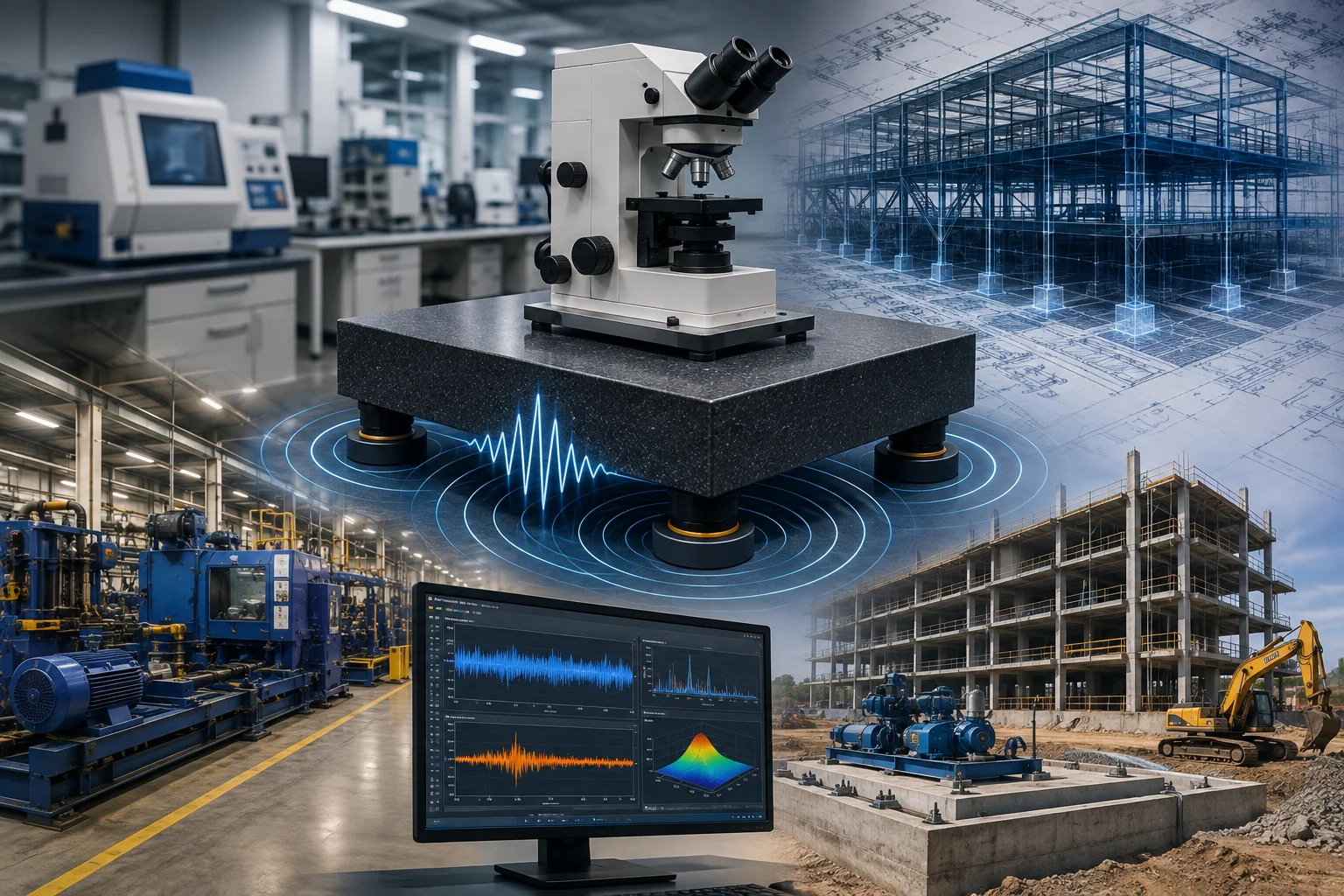
In laboratories, manufacturing facilities, industrial plants, and other specialized environments, a structure may need to do more than simply support its required loads. It may also need to control movement and vibration.
Equipment such as precision instruments, manufacturing machinery, testing systems, imaging equipment, and other sensitive technologies can be affected by vibrations that may seem insignificant to building occupants. At the same time, operating machinery can generate dynamic forces that travel through floors, structural framing, foundations, and surrounding areas.
Vibration and dynamic analysis helps engineers understand how a structure responds to these forces and whether vibration could affect equipment performance, operations, occupant comfort, or the building itself.
For projects involving vibration-sensitive equipment or dynamic machinery, addressing these concerns early can help reduce risk, avoid costly modifications, and support reliable long-term performance.
Structural vibration is the repeated movement or oscillation of a building component in response to a force.
Every structure experiences some degree of movement. Walking across a floor, operating mechanical equipment, moving materials, or running industrial machinery can create vibrations.
In many conventional buildings, these vibrations may have little practical impact. However, facilities containing highly sensitive equipment or specialized operations can have much stricter performance requirements.
A floor that feels perfectly stable to a person, for example, may still experience enough movement to interfere with a precision instrument.
Vibration and dynamic analysis evaluates how structures respond to forces that vary with time.
Traditional structural design considers loads such as the weight of the building, occupants, equipment, wind, and other applicable forces. Dynamic analysis goes further by considering how moving, rotating, reciprocating, or impact-producing forces interact with the structure.
Depending on the project, engineers may evaluate factors such as:
The objective is to determine whether the structure and equipment can perform together within appropriate project criteria.
Many modern facilities depend on equipment capable of extremely precise measurements or operations.
Laboratories may contain microscopes, analytical instruments, testing equipment, or other systems that require a stable environment. Manufacturing facilities may use precision machining, inspection, calibration, or automated production equipment.
Excessive vibration can potentially contribute to problems such as inaccurate measurements, reduced equipment performance, disrupted processes, compromised product quality, or difficulty maintaining required operational tolerances.
This makes vibration control more than an occupant-comfort issue. In some facilities, it can directly affect productivity and the ability to perform critical operations.
Vibration can originate both inside and outside a facility.
Rotating machinery, compressors, pumps, fans, generators, motors, presses, and other equipment can produce recurring dynamic forces during operation.
If the equipment and supporting structure are not appropriately coordinated, these forces can travel through floors and framing into other parts of the building.
Walking, carts, material handling, forklifts, and other routine activities can generate floor vibrations.
In most buildings, these movements are relatively minor. In highly sensitive laboratory or precision manufacturing environments, however, even ordinary activity may need to be considered.
Pile installation, excavation, compaction, demolition, and heavy construction equipment can generate temporary vibration.
Facilities containing sensitive equipment may need to consider how nearby construction activities could affect ongoing operations.
Road traffic, railways, industrial operations, and other nearby activities can introduce vibration into a site.
These forces can potentially travel through the ground and into building foundations.
Heavy machinery can create structural demands that differ significantly from static equipment weight.
A machine may weigh a certain amount while sitting idle, but operating that machine can introduce repeated, rotating, reciprocating, or impact forces.
These dynamic forces may influence the equipment support system, floor slab, structural framing, connections, and foundation.
Simply verifying that a floor can support the equipment's weight may therefore be insufficient for some installations.
The way the equipment operates matters too.
One important concept in dynamic behavior is resonance.
Structures and structural components have natural frequencies at which they tend to vibrate. Equipment and repetitive activities can also produce forces at particular frequencies.
When forcing frequencies approach a structure's natural frequency, the resulting vibration response may become amplified.
Engineering analysis can help identify potential frequency conflicts and determine whether changes to structural stiffness, equipment support, isolation, layout, or other design elements should be considered.
Laboratories are among the facilities where vibration performance can be particularly important.
Equipment may have manufacturer-defined vibration criteria or operational requirements that are considerably more restrictive than typical building comfort standards.
Potential considerations include the location of sensitive instruments, structural floor system, column spacing, nearby corridors, mechanical rooms, elevators, equipment, exterior traffic, and other potential vibration sources.
Addressing these requirements during design can provide more flexibility than attempting to correct vibration problems after a facility is occupied.
Manufacturing environments present a different challenge because the equipment itself may be a major source of vibration.
Production machinery may generate dynamic forces continuously or intermittently. Multiple machines operating simultaneously can further complicate structural response.
Before installing or relocating significant machinery, project teams may benefit from evaluating:
This becomes particularly important when an existing building is being converted to a new industrial use.
Vibration performance does not stop at the floor or structural frame.
Foundations and underlying soils can influence how dynamic forces are transferred and how a structure responds.
Depending on the project, geotechnical conditions may therefore be an important part of evaluating vibration-sensitive structures or equipment foundations.
Coordination between structural and geotechnical engineering can help project teams better understand how equipment, structure, foundation, and subsurface conditions interact.
Vibration considerations can arise during both new construction and modifications to existing facilities.
For new buildings, evaluating sensitive equipment and operational requirements early allows the structural system to be developed with those needs in mind.
Existing facilities can be more challenging because the building was not necessarily designed for the equipment or operations being introduced.
Before installing new machinery or converting a space into a laboratory or specialized manufacturing area, an engineering evaluation can help determine whether the existing structure is appropriate or whether modifications should be considered.
A professional engineering evaluation may be appropriate when:
These conditions do not automatically indicate a structural deficiency. They may, however, justify further investigation.
Vibration problems can become difficult and expensive to address after construction or equipment installation.
Potential corrective measures may involve equipment relocation, structural reinforcement, modified foundations, vibration isolation systems, or changes to operational layouts.
Early coordination allows engineers, architects, equipment suppliers, contractors, and owners to consider vibration requirements while there is still flexibility in the design.
For specialized facilities, this can help protect both the building investment and the equipment operating inside it.
A structure can have adequate strength and still fail to provide the performance required for sensitive operations.
That distinction is important.
For laboratories and manufacturing facilities, successful structural engineering may require consideration of strength, stiffness, vibration response, equipment requirements, foundation conditions, and operational performance.
Vibration and dynamic analysis helps connect these factors so that the building can support not only the equipment's weight but also the way that equipment actually operates.
Sensitive equipment and dynamic machinery can introduce engineering requirements that should not be overlooked during facility planning, expansion, or renovation.
Understanding vibration sources, structural response, equipment requirements, and foundation conditions early can help reduce operational disruptions, protect valuable equipment, and support reliable long-term building performance.
Planning a laboratory, manufacturing facility, industrial project, or equipment installation? Contact Isbell Engineering Consultants for experienced structural and geotechnical engineering support. Our team can help evaluate structural conditions, dynamic loading considerations, foundation requirements, and vibration-sensitive operations to support informed project decisions.
Copyright © 2026 Isbell Engineering Consultants - All Rights Reserved.
Made & Managed by North Texas Business Solutions