
ICC 500 and FEMA P-361: Storm Shelter Design for Schools and Public Buildings
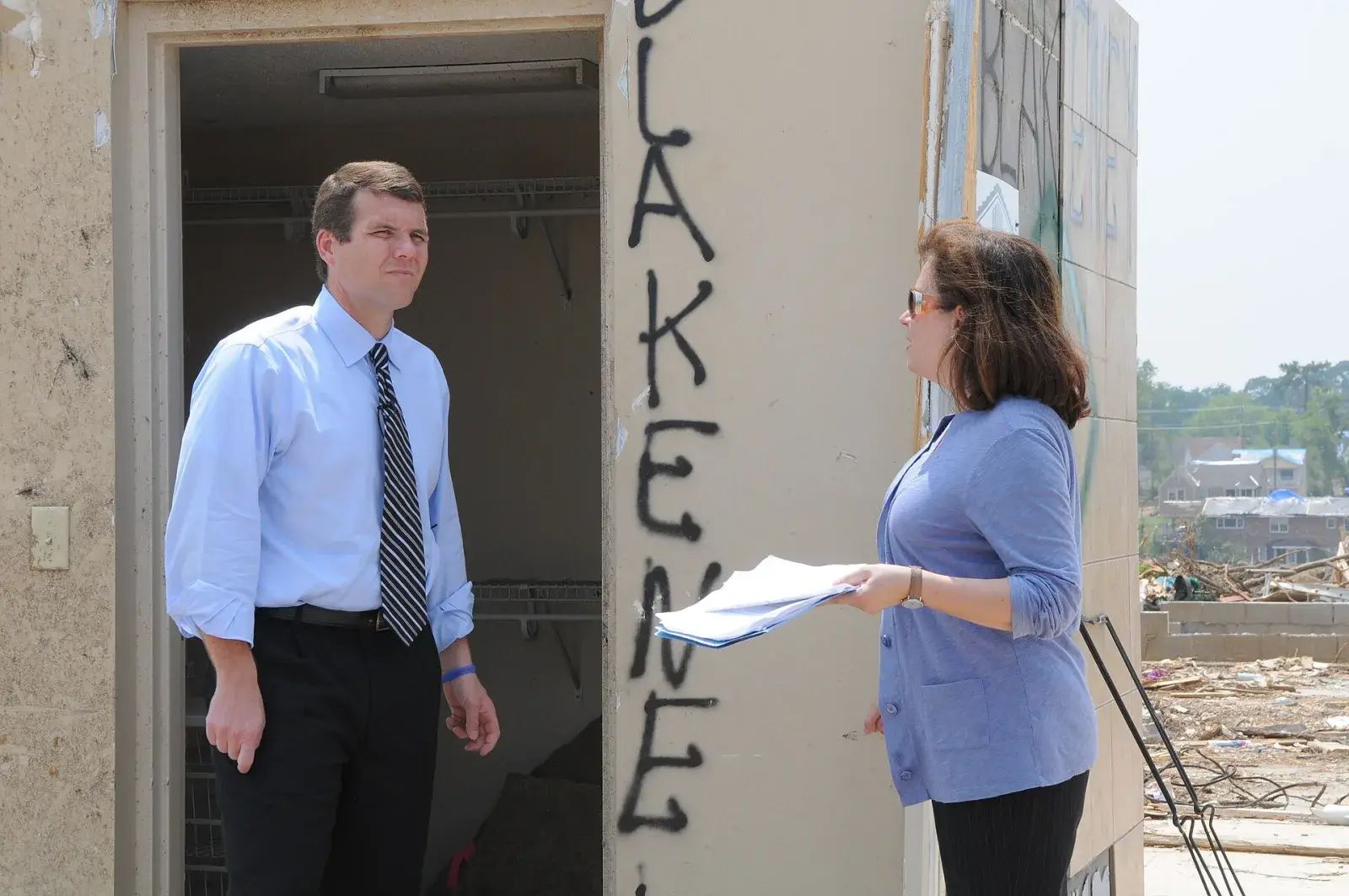
Tuscaloosa, Alabama, June 2011: FEMA staff interview the mayor in front of a safe room that remained standing after the 2011 tornado. (Photo: FEMA (Department of Homeland Security, Federal Emergency Management Agency) · Public domain (US gov))

ICC 500 is the national standard for designing and building storm shelters. The International Building Code makes it mandatory for certain new buildings in the highest tornado-risk zone, most notably K-12 schools and emergency services facilities. FEMA P-361 is FEMA's guidance for "safe rooms." It overlaps heavily with ICC 500, but it adds criteria that apply whenever FEMA grant money pays for the project. If you're a school district, city or county planning a new building in North Texas or Oklahoma, you'll likely deal with one or both.
What is ICC 500?
ICC 500, the ICC/NSSA Standard for the Design and Construction of Storm Shelters, was first published in 2008 and updated in 2014, 2020 and 2023. It covers tornado and hurricane shelters. It sets the design loads, the debris-impact resistance, occupant space, ventilation, sanitation, lighting, and the quality assurance needed to build them.
It defines two classes:
- Residential shelters, with an occupant capacity "not exceeding 16 people"
- Community shelters, meaning everything else: schools, public buildings, workplaces, standalone community shelters
ICC 500 shelters are designed for the most intense tornadoes. For scale, NOAA's Storm Prediction Center rates an EF4 tornado at 166–200 mph and an EF5 at over 200 mph (3-second gust). In the tornado-prone zone, ICC 500's tornado shelter design speed is 250 mph.
When does the building code require a storm shelter?
Section 423 of the 2015, 2018, 2021 and 2024 editions of the IBC requires certain new buildings to include an ICC 500 storm shelter. The requirement applies where the building is in the 250 mph tornado zone on ICC 500 Figure 304.2. As FEMA summarizes it, the buildings covered are:
- 911 call stations
- Emergency operations centers
- Fire, rescue, ambulance and police stations
- "K–12 school buildings with an occupant load of 50 or more, with certain exceptions"
For schools, the 2021 IBC's Group E provisions set two practical rules. The shelter has to hold the greater of the total occupant load of the classrooms, vocational rooms and offices, or the occupant load of the largest indoor assembly space. And the travel distance from at least one exterior door of each building to a shelter door can't exceed 1,000 feet. The exceptions include day care facilities and Group E spaces accessory to places of religious worship.
Section numbers shift between IBC editions. In the 2021 and 2024 IBC, critical emergency operations and Group E sit at Sections 423.4 and 423.5, while the 2018 edition numbers them differently. Texas cities adopt different editions with local amendments, and unincorporated areas may have no adopted building code. Check which edition and which amendments apply with the authority having jurisdiction. Additions to existing school buildings can also trigger shelter requirements under the International Existing Building Code.
ICC 500 vs. FEMA P-361: what's the difference?
FEMA P-361, Safe Rooms for Tornadoes and Hurricanes, is now in its fifth edition (2024). It uses ICC 500 as its technical base and layers FEMA's own criteria on top. Those extra criteria become mandatory when the project receives FEMA funding, such as hazard mitigation grants.
| ICC 500 storm shelter | FEMA P-361 safe room | |
|---|---|---|
| What it is | Consensus standard, referenced by the IBC | FEMA guidance document |
| When it's mandatory | When the IBC Section 423 trigger applies, or a jurisdiction adopts it | When FEMA grant funds pay for the safe room (Part B "FEMA Funding Criteria") |
| Tornado design speed | Mapped, up to 250 mph in the highest zone | FEMA-funded residential safe rooms: 250 mph "regardless of location or storm type"; community safe room criteria per P-361 |
| Protection goal | Life-safety shelter meeting code | "Near-absolute protection," meaning occupants have "a very high probability of being protected from injury or death" |
| Documentation | Sealed construction documents, quality assurance, peer review, special inspection provisions in the standard | ICC 500 provisions plus FEMA's additional funding criteria |
| Existing standard | ICC 500-2023 is current; FEMA notes the ICC 500-2014 grace period for its programs ended January 1, 2024 | P-361 5th edition (2024); P-320 6th edition (2024) for residential |
The short version: every FEMA safe room is designed to ICC 500, but a building that meets ICC 500 doesn't automatically qualify for FEMA funding. Decide early whether grant money is in play, because it affects design criteria, documentation and schedule.
What changed in ICC 500-2023?
FEMA's summary of the 2023 edition lists these changes that matter to owners and designers:
- "Wind speeds" became "tornado speeds" and "tornado loads," and the referenced load standard moved to ASCE 7-22
- New performance-based design options
- Topographic and exposure effects removed from tornado load calculations
- An emergency escape opening that must be separated from the egress door by at least one-third of the shelter's overall diagonal
- Tornado shelter mechanical ventilation reduced from 5 to 2.5 cfm per occupant
- A new written evaluation and maintenance plan requirement
- New pass/fail criteria for pressure testing
Two earlier requirements still catch people out. When a community shelter sits inside a larger host building, the separating walls and floors need a minimum 2-hour fire-resistance rating. Critical support systems located outside the shelter must be protected "to the same level as the storm shelter." Designers also can't reduce wind or debris loads by counting on shielding from the host building or neighboring buildings.
How the design process works
A storm shelter is mostly a structural engineering problem: a hardened box that resists extreme pressure and wind-borne debris and stays anchored to its foundation. In practice the process runs like this:
- Confirm the trigger. Check the adopted IBC edition, the tornado zone on ICC 500 Figure 304.2, the occupancy and occupant load, and whether FEMA funds are involved.
- Pick the shelter type. The options are a standalone shelter, a shelter area inside a new building (often a gym, corridor block or cafeteria), or an addition.
- Set capacity and location. Use the occupant load rules and the 1,000-foot travel limit for schools, plus accessibility.
- Foundation and anchoring. Uplift and overturning forces on a shelter are large. On North Texas and Oklahoma expansive clay, the foundation design has to handle both the shelter loads and soil movement. FEMA's 2024 fact sheet notes that post-installed anchors trigger special inspection under ICC 500.
- Envelope and openings. Walls, roof, doors, windows and vents must use tested assemblies rated for the design debris impact and pressure. Doors and their hardware are part of that tested envelope, so specify them early.
- Construction documents and peer review. ICC 500 requires documents "prepared and sealed by a registered design professional," with provisions for quality assurance, peer review, special inspection and structural observation.
- Construction and close-out. This covers special inspections, structural observation, and the 2023 edition's evaluation and maintenance plan.
Owner checklist
- Confirm the IBC edition and local amendments with the building official
- Confirm the tornado zone (ICC 500 Figure 304.2) for the site
- Decide whether FEMA or other grant funding will be used, and build P-361 Part B criteria in from the start if so
- Calculate required shelter capacity from occupant loads
- Check travel distance from each building to a shelter door (schools)
- Order a geotechnical investigation early, because foundation uplift design depends on it
- Budget for peer review, special inspections and tested door and opening assemblies
- Plan for the shelter's everyday use (gym, classrooms, offices) so it earns its space between storms
- Assign responsibility for the operations and maintenance plan
Shelter projects and next steps
Isbell Engineering Consultants' project gallery includes the Atoka Safe Room and the Wynnewood Tornado Shelter. The firm's structural engineering services include structural design and blast and impact-resistant design, with geotechnical recommendations for the foundation available from the same office. If a school, public safety building or community shelter is in your capital plan, send the program and site location through the contact page to talk through code triggers and design criteria.
Frequently asked questions
What is ICC 500?
ICC 500 is the ICC/NSSA Standard for the Design and Construction of Storm Shelters. It sets structural, debris-impact and life-safety requirements for tornado and hurricane shelters. The current edition is 2023.
Is ICC 500 required for schools in Texas?
Where a jurisdiction has adopted the 2015 or later IBC without amending Section 423, new K-12 school buildings with an occupant load of 50 or more in the 250 mph tornado zone generally need an ICC 500 shelter, with some exceptions. Adoption and amendments vary by city, so confirm with the local building official.
What is the difference between FEMA P-361 and ICC 500?
ICC 500 is a code-referenced consensus standard. FEMA P-361 is FEMA's safe room guidance. It builds on ICC 500 and adds funding criteria that become mandatory when FEMA grants pay for the project.
What is a FEMA safe room?
FEMA defines a safe room as a hardened structure built to its criteria that provides "near-absolute protection" in extreme wind events, meaning occupants have a very high probability of avoiding injury or death.
How many people can a residential storm shelter hold under ICC 500?
A residential shelter under ICC 500 has an occupant capacity of no more than 16 people. Anything larger is a community shelter.
Sources
- FEMA, Highlights of ANSI/ICC 500-2023 (Nov 2024)
- FEMA, Foundation and Anchoring Criteria for Safe Rooms (Nov 2024)
- FEMA, Safe Rooms
- FEMA, Safe Room Resources (FEMA P-361, P-320)
- ICC 500-2023 ICC/NSSA Standard for the Design and Construction of Storm Shelters
- IBC Section 423 Group E occupancies (UpCodes, 2021 IBC text)
- IBC Section 423 Critical emergency operations (UpCodes, 2024 IBC text)
- NOAA Storm Prediction Center, Tornado FAQ (Enhanced Fujita scale)
Image credits
- Concrete safe room left standing among tornado debris in Tuscaloosa, Alabama, in 2011, with FEMA staff and the city's mayor outside. Photo: FEMA (Department of Homeland Security, Federal Emergency Management Agency) · Public domain (US gov)
Related articles
- Delegated Design and Deferred Submittals: Who Engineers What on a Commercial Project
- Shoring in Construction: The Main Types, the OSHA Lines, and When an Engineer Has to Design It
- Structural Health Monitoring for Commercial Buildings: What to Measure, How Long, and What the Readings Mean on North Texas Clay
Copyright © 2026 Isbell Engineering Consultants - All Rights Reserved.
Made & Managed by North Texas Business Solutions