
Structural Health Monitoring for Commercial Buildings: What to Measure, How Long, and What the Readings Mean on North Texas Clay
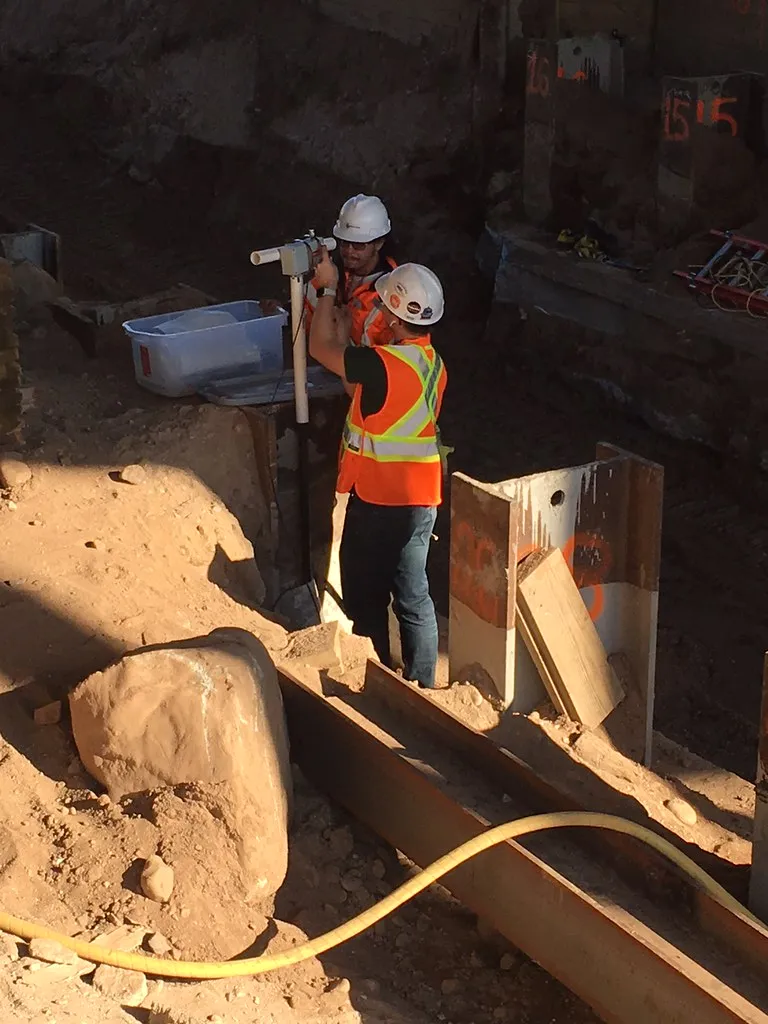
Testing an inclinometer installed on a secant pile wall beside an excavation. Readings from the casing show how much the ground is moving sideways and at what depth. (Photo: MTA C&D - East Side Access, CC BY 2.0, via Flickr · CC BY 2.0 · cropped and resized)
Structural health monitoring (SHM) means putting instruments on a structure, or in the ground under it, and reading them over time so an engineer can tell whether it is moving, cracking or straining more than it should. For a commercial building that can be as simple as crack monitors and a level survey repeated every few months, or as involved as strain gauges and tiltmeters logging to a server. An engineer then compares the readings with a baseline and with the seasons.
Most material on SHM is written about bridges and research projects. This guide is for owners and managers of offices, retail and mixed-use buildings, and for the teams building next to them.
What is structural health monitoring?
Wikipedia's entry quotes one of the field's foundational papers, which defines SHM as the process of implementing a damage identification and characterization strategy with the eventual goal of predicting the remaining life of the structure. Long-term monitoring gives periodically updated information on whether a structure can keep doing its job. After an extreme event, the same data is used for rapid screening.
The entry lists the problem in stages of increasing difficulty: detect that damage exists, locate it, identify its type, and quantify how severe it is. Most building monitoring programs aim at the first two. They answer whether something is moving and where, and leave the "why" to the engineer's investigation.
Two of the field's working principles apply directly to buildings. Sensors don't measure damage directly, so the data has to be processed and interpreted before it says anything about the structure. And the more sensitive a measurement is to damage, the more sensitive it usually is to changes in operating and environmental conditions. In North Texas, the environmental condition that matters most is soil moisture.
Why North Texas buildings move with the seasons
USDA's official description of the Houston Black series, a clay soil of large extent across the Texas Blackland Prairies and the eastern Grand Prairie, records shrink-swell potential with cracks 1/2 to 4 inches wide at a foot deep during dry periods. In most years those cracks stay open for 90 to 150 cumulative days.
The 2021 IBC (§1803.5.3) treats soil as expansive when it meets four tests, starting with a plasticity index of 15 or more. A building on that kind of soil goes up and down with wet and dry seasons even when nothing is wrong with it. A crack that opens in August and closes in March may be ordinary seasonal movement. A crack that keeps widening through a full wet-dry cycle points to a different problem.
This is why short monitoring periods mislead on clay. Readings taken over a few weeks in one season can't separate a progressive problem from the normal swing. Plan to cover at least one full wet and dry cycle when the question is whether a foundation is still moving.
What can be measured, and with what
| What you want to know | Instrument | Typical use on a commercial building |
|---|---|---|
| Is this crack getting wider? | Crack monitor (tell-tale gauge) or displacement transducer | Masonry, drywall and slab cracks after a complaint |
| Is the floor moving up or down? | Repeated relative elevation (level) survey | Slab-on-grade and foundation movement on clay |
| Is a wall or column leaning more? | Tiltmeter or survey prisms | Retaining walls, tall masonry walls, buildings next to excavations |
| How hard is this member working? | Strain gauges | Transfer beams, long-span roof members, retrofitted elements |
| How does the structure respond to vibration? | Accelerometers | Floors with vibration complaints, construction vibration near the building |
| Is the ground moving sideways? | Slope inclinometer | Slopes, retaining walls, deep excavations |
| What is the groundwater doing? | Piezometer | Dewatering, slopes, sites with perched water |
| How much is fill or a footing settling? | Settlement plate or settlement point | New fills, embankments, structures near heavy loads |
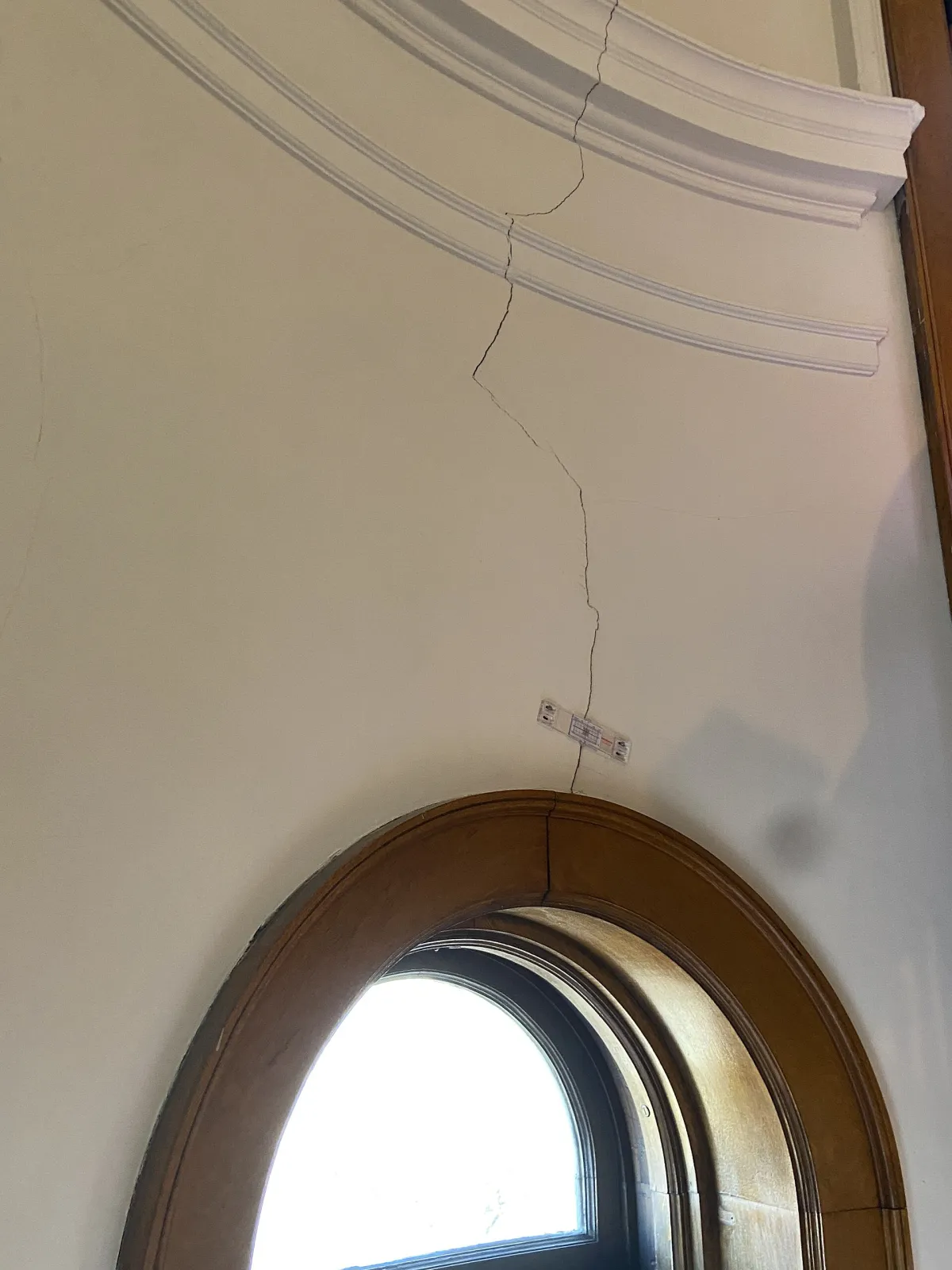
The first two rows cover most building complaints, and they're cheap. A crack monitor glued across a crack and photographed on a schedule, plus a level survey of the floor from a fixed benchmark, often answers the owner's real question: is it still moving?
The geotechnical instruments, in more detail
Ground movement is where many building problems start, and the FHWA's Soils and Foundations Reference Manual (NHI-06-088) describes the standard instruments plainly.
A slope inclinometer is usually a plastic casing with a 3-inch inside diameter and four grooves at 90-degree spacing, installed in a borehole with its bottom in firm soil or rock. A probe lowered down the grooves measures the tilt of the casing, which gives the amount and depth of sideways movement. The manual makes a point that applies to any monitoring program: the rate of movement is a better warning sign than the total amount, and readings should be plotted against time as soon as they are taken.
Piezometers measure water pressure in the soil. The simplest is an open standpipe, which is cheap but easily damaged by equipment and slow to respond in clay. Vibrating wire and pneumatic piezometers respond faster.
Settlement plates are steel or plywood plates, 3 to 4 feet square, set at the original ground surface with a rod extended up through the fill so the plate's elevation can be surveyed.
FHWA also says who should run this. The instrument types and locations should be planned by a qualified geotechnical specialist, and the data interpreted by someone with a soil mechanics background. Building monitoring needs the same: a named engineer who reads and interprets the data.
When monitoring is worth paying for
Monitoring earns its cost when a decision depends on whether something is still moving:
- Before a foundation repair or retrofit decision on an existing building with cracks, to tell seasonal movement from progressive movement.
- During excavation, dewatering or pile driving next to an occupied building, so the contractor can stop work if readings pass agreed limits.
- After a renovation that changes load paths, to confirm that new or strengthened members behave as designed.
- On slopes and retaining walls that show early signs of movement.
- After an event such as a vehicle impact, flood or nearby collapse, for rapid screening of what changed.
It's usually not worth it for a single hairline crack with no pattern, or for a question that one structural inspection can answer on the day.
How to set up a monitoring program
- Define the question. "Is the east wall still rotating?" leads to a better program than "monitor the building."
- Take a baseline before anything changes: before excavation starts, before repairs, or at the first visit.
- Choose the fewest instruments that answer the question, and put them where the movement is expected.
- Set threshold levels in advance, usually a review level and an action level, with a named person who acts on each.
- Fix the reading schedule. Read more often during active construction, less often for long-term building monitoring, and cover a full wet-dry season on clay.
- Record conditions with every reading: rainfall, temperature and construction activity, so the engineer can separate seasonal swings from real change.
- Plot readings against time immediately and look at the rate, not only the total.
- Decide in advance who owns the data and how long it's kept.
If monitoring shows progressive movement, the next step is an investigation into the cause. That's a forensic engineering question, and the monitoring record becomes part of the evidence.
Talk to Isbell Engineering Consultants about monitoring
Isbell Engineering Consultants lists structural health monitoring for office buildings, retail spaces and mixed-use developments among its structural engineering services, and geotechnical instrumentation and monitoring, including settlement monitoring and inclinometers and piezometers for slope and groundwater observation, among its geotechnical services. If you have cracks you want tracked, or construction planned next to an occupied building, send the details through our contact page.
Frequently asked questions
What is structural health monitoring?
It's the repeated measurement of a structure's movement, strain or vibration, compared with a baseline, to detect and locate damage and judge whether the structure can keep doing its job.
What sensors are used for structural health monitoring?
Common ones are crack monitors, displacement transducers, tiltmeters, strain gauges and accelerometers on the structure, with inclinometers, piezometers and settlement plates in the ground.
How do you monitor structural movement in a building?
The simplest method is crack gauges read on a schedule plus repeated level surveys of the floor from a fixed benchmark. Tiltmeters and automated sensors are added when movement is fast or the risk is high.
How long should a building be monitored on expansive clay?
Long enough to cover at least one full wet and dry season, because clay soils shrink and swell with moisture and a short record can't separate seasonal movement from progressive movement.
Who should interpret monitoring data?
An engineer. FHWA guidance says instrument programs should be planned by a qualified geotechnical specialist and the data interpreted by someone with a soil mechanics background, and structural readings need a structural engineer's review.
Sources
- Wikipedia, Structural health monitoring
- FHWA NHI-06-088, Soils and Foundations Reference Manual, Volume I (2006), §7.9.1 Embankment Construction Monitoring by Instrumentation
- USDA NRCS, Official Series Description: Houston Black series
- 2021 IBC Chapter 18, Soils and Foundations, §1803.5.3 and §1808.6 (Texas, via UpCodes)
Image credits
- Two workers in hard hats taking a reading from an inclinometer casing at the edge of a deep excavation. Photo: MTA C&D - East Side Access, CC BY 2.0, via Flickr · CC BY 2.0 · cropped and resized
- A crack monitor fixed across a crack in an interior wall above an arched window. Photo: Myotus, CC BY 4.0, via Wikimedia Commons · CC BY 4.0 · resized

Related articles
Copyright © 2026 Isbell Engineering Consultants - All Rights Reserved.
Made & Managed by North Texas Business Solutions