
Proctor Test Basics: Standard vs. Modified and Why Compaction Specs Matter
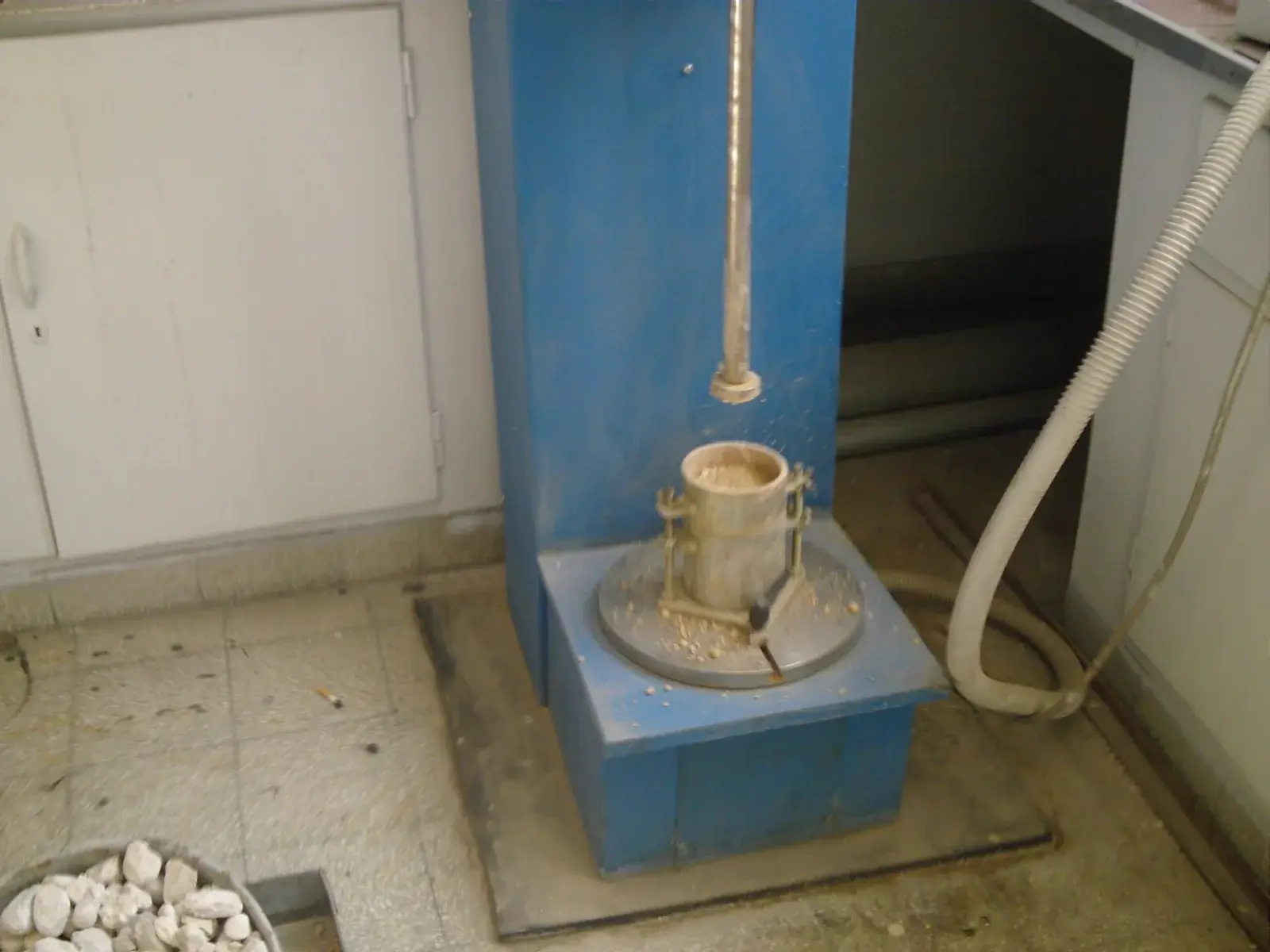
A mechanical Proctor compactor. The hammer drops a fixed height onto soil in a standard mold, layer by layer. (Photo: Zaher.Kadour · CC BY-SA 3.0 · cropped and resized)

A Proctor test is a lab test that finds the maximum dry density a soil can reach under a set compaction effort, and the moisture content at which it gets there (the "optimum moisture content"). Field crews then compact fill until a density test shows it has reached a specified percentage of that maximum, inside a specified moisture range. Get either number wrong and you can end up with fill that settles, or with clay that swells under a slab.
Most confusion comes from three things: which Proctor (standard or modified) the spec refers to, what "95%" is a percentage of, and why the moisture window matters as much as the density. This guide covers all three.
How the Proctor test works
The procedure is set by ASTM D698 (standard effort) and ASTM D1557 (modified effort). FHWA's soils and foundations manual summarizes it: at least three, and preferably five, samples of the same soil are mixed at different water contents and compacted into a mold. The technician weighs each one, measures its water content, and calculates its dry density. Plotting dry density against moisture gives a hump-shaped compaction curve. The peak of the curve is the maximum dry density, and the moisture content at that peak is the optimum.
Standard vs. modified Proctor
Both tests use the same mold. The difference is how hard the soil gets hit.
| Standard Proctor | Modified Proctor | |
|---|---|---|
| ASTM / AASHTO | D698 / T 99 | D1557 / T 180 |
| Mold | 4 in. diameter, 1/30 ft³ | 4 in. diameter, 1/30 ft³ |
| Hammer | 5.5 lb, 12 in. drop | 10 lb, 18 in. drop |
| Layers × blows per layer | 3 × 25 | 5 × 25 |
| Energy | 12,375 ft-lb/ft³ | 56,250 ft-lb/ft³ |
| Result on the same soil | Lower max dry density, higher optimum moisture | Higher max dry density, lower optimum moisture |
| Where you usually see it | Clay fill, building pads, subgrade in clay country | Granular base, select fill, heavily loaded pavements |
Source: FHWA NHI-06-088, Table 5-13. Both tests are run on the minus No. 4 fraction.
FHWA notes that modified effort is 4.5 times the standard effort. More energy squeezes the soil denser at a lower water content, so the two curves sit in different places. That has a practical consequence that trips people up. FHWA points out that "95% of MPC [modified] γd-max may be greater than 100% of SPC [standard] γd-max," and that 1 or 2 percent above the modified optimum may still be below the standard optimum. A spec that says "95% compaction" without naming the test is incomplete.
What "95% Proctor" means: decoding a compaction spec
FHWA says a compaction spec should be written in terms of three parameters: the compaction energy (standard or modified), the target dry density as a percentage of maximum, and the moisture range relative to optimum. Here's a spec line of the kind you'll see in a North Texas geotechnical report, decoded:
Compact fill to at least 95% of the maximum dry density per ASTM D698 at a moisture content between -1 and +3 percentage points of optimum.
| Part of the spec | What it means |
|---|---|
| "ASTM D698" | Use the standard Proctor curve for this soil as the reference |
| "at least 95% of the maximum dry density" | Field dry density must be 95% or more of the lab peak |
| "-1 to +3 percentage points of optimum" | Field moisture must sit in a window around the lab optimum, skewed to the wet side |
A worked example with illustrative numbers: if the lab curve for a clay gives a maximum dry density of 105 pcf at 18% optimum moisture, a passing field test needs at least 99.75 pcf (0.95 × 10⁵) and a moisture content between 17% and 21%. A test at 101 pcf and 15% moisture fails, even though the density passes, because the soil is too dry.
Why clay in North Texas is compacted wet of optimum
A first-time reader often thinks "drier and denser is always better." On expansive clay, it isn't.
FHWA's pavement geotechnics manual explains that "swelling of compacted clays is greater when compacted dry of optimum," because dry clay has a greater capacity to absorb water. Clay compacted dry of optimum also ends up with a flocculated structure that's stronger and stiffer at first, but FHWA warns that if it later becomes saturated, its strength can drop below that of the same soil compacted wet. FHWA also notes that permeability compacted dry of optimum is "about an order of magnitude higher" than when compacted wet.
That's why geotechnical engineers working on Blackland Prairie clay often specify a moderate density with moisture on the wet side of optimum. Driving a high-plasticity clay to a high density at low moisture produces a dense, dry layer with plenty of capacity to take on water and swell later. FHWA's own general guidance for cohesive fill under pavements is "no less than 90%... near or slightly greater than optimum moisture content (e.g., -1% to +2% of optimum), as defined by AASHTO T99." Your project spec may differ, and it should come from your geotechnical report, not a generic number.
What the building code requires
The 2021 IBC addresses compacted fill in three places:
- §1803.5.8 requires a geotechnical investigation where shallow foundations bear on compacted fill more than 12 inches deep. The report must give site-preparation specs, fill material specs, the test method for maximum dry density and optimum moisture, maximum lift thickness, the field density test method, the minimum in-place density as a percentage of maximum, and the number and frequency of field tests.
- §1804.6 lets fill 12 inches deep or less skip an approved report if in-place dry density is at least 90% of the maximum dry density per ASTM D1557, verified by special inspection.
- Table 1705.6 requires special inspection of soils. It requires continuous inspection during fill placement to verify materials, procedures, densities and lift thicknesses, and periodic inspection of the subgrade before fill goes down.
Notice that the code's default for thin fill is the modified test at 90%. A report written for a clay site usually replaces that with a project-specific standard Proctor spec and moisture range.
How compaction is checked in the field
The most common field test is the nuclear moisture-density gauge, run under ASTM D6938. FHWA lists the usual in-place methods as nuclear density, sand cone, balloon or drive tube, with moisture from the nuclear gauge, a speedy moisture tester or oven drying. The technician compares each result to the Proctor curve for that soil.
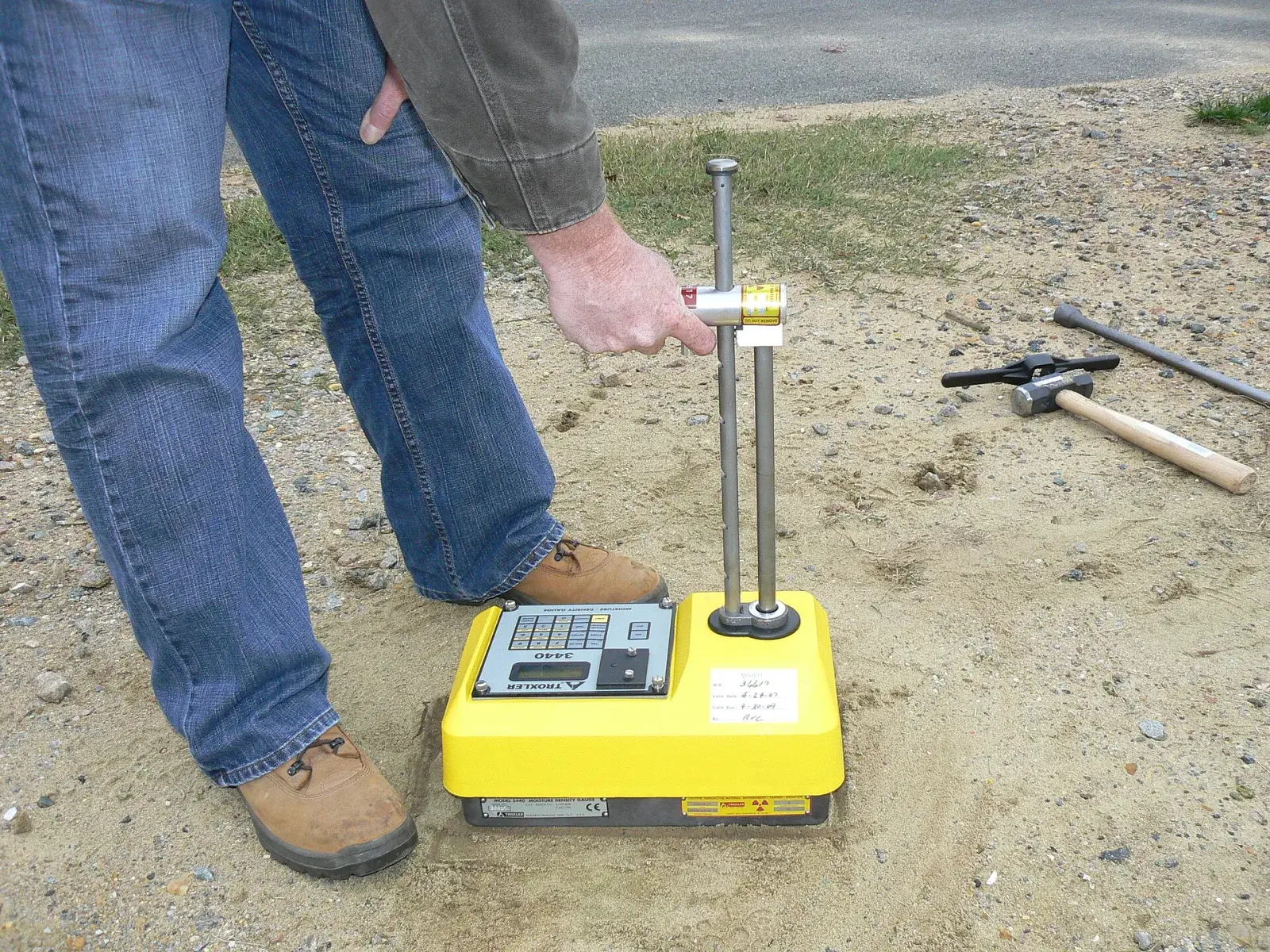
The gauge is only as good as the Proctor it's compared against. If the borrow source changes partway through the job, the old curve no longer applies, and a passing number can be meaningless.
Field QA checklist for earthwork on clay sites
- Confirm the spec names the test (D698 or D1557), the density percentage and the moisture window
- Get a Proctor on each distinct soil type actually being placed, and a new one when the borrow source changes
- Check loose lift thickness before rolling. FHWA notes lifts are typically 6 to 12 inches, set by soil type and equipment
- Match the compaction equipment to the soil. FHWA's guidance stresses equipment weight and width
- Test every lift at the frequency the geotechnical report specifies. Don't save tests for the top lift
- Treat a dry-side failure as seriously as a low-density failure on expansive clay
- Keep finished pads from drying out before the slab is placed, or rework and retest them
- Proof roll subgrade where the report calls for it, and fix soft areas before the next lift
Getting the compaction spec right for your site
Isbell Engineering Consultants prepares geotechnical recommendations that include fill and subgrade preparation, ground improvement such as compaction and chemical treatment, and pavement subgrade evaluation. On the civil side we handle grading and paving design, so the earthwork spec matches the plans the contractor is building from. See our geotechnical engineering services and civil engineering services, or reach us through the contact page with your site plan and boring data.
Frequently asked questions
What is a Proctor test used for?
It sets the reference for compaction. The lab finds the maximum dry density and optimum moisture for a soil under a standard effort. Field density tests are then compared against those numbers to decide whether fill and subgrade have been compacted to spec.
What does 95% Proctor mean?
The compacted soil in the field has a dry density of at least 95% of the maximum dry density from the lab Proctor test. The spec should also say which test (standard or modified) and what moisture range is allowed.
What is the difference between standard and modified Proctor?
Modified Proctor uses a heavier hammer (10 lb vs. 5.5 lb), a higher drop (18 in. vs. 12 in.) and five layers instead of three, for 4.5 times the energy. It produces a higher maximum density at a lower optimum moisture, so 95% modified is a tougher target than 95% standard.
Why does my spec allow moisture above optimum?
On expansive clay, soil compacted on the wet side of optimum swells less when it gets wet later. FHWA notes that clays compacted dry of optimum swell more. A wet-side window helps control slab and pavement movement.
How is a soil compaction test done in the field?
Usually with a nuclear moisture-density gauge (ASTM D6938), which reads in-place density and moisture in a few minutes. Sand cone and other methods are also used. Each result is compared against the Proctor curve for that soil.
Sources
- FHWA NHI-06-088, Soils and Foundations Reference Manual, Vol. I, §5.8 Compaction Tests (Table 5-13)
- FHWA NHI-05-037, Geotechnical Aspects of Pavements, Ch. 7 §7.4 Compaction (effect on soil properties)
- FHWA NHI-05-037, Geotechnical Aspects of Pavements, Ch. 7 subgrade improvement (fill compaction guidance)
- FHWA NHI-05-037, Geotechnical Aspects of Pavements, Ch. 8 Construction (QC/QA, lift thickness, field density tests)
- ASTM D698, Laboratory Compaction Characteristics of Soil Using Standard Effort
- ASTM D1557, Laboratory Compaction Characteristics of Soil Using Modified Effort
- ASTM D6938, In-Place Density and Water Content of Soil and Soil-Aggregate by Nuclear Methods
- 2021 International Building Code as adopted in Texas, Chapter 18 (§1803.5.8, §1804.6)
- 2021 International Building Code as adopted in Texas, Chapter 17 (§1705.6, Table 1705.6)
Image credits
- Proctor test apparatus with a compaction mold and drop hammer in a soils laboratory. Photo: Zaher.Kadour · CC BY-SA 3.0 · cropped and resized
- Technician taking a reading with a nuclear moisture-density gauge on compacted soil. Photo: Nuclear Regulatory Commission from US · CC BY 2.0 · resized

Related articles
Copyright © 2026 Isbell Engineering Consultants - All Rights Reserved.
Made & Managed by North Texas Business Solutions