
Construction Dewatering: How It Works, Which Method Fits the Soil and What the Rules Require
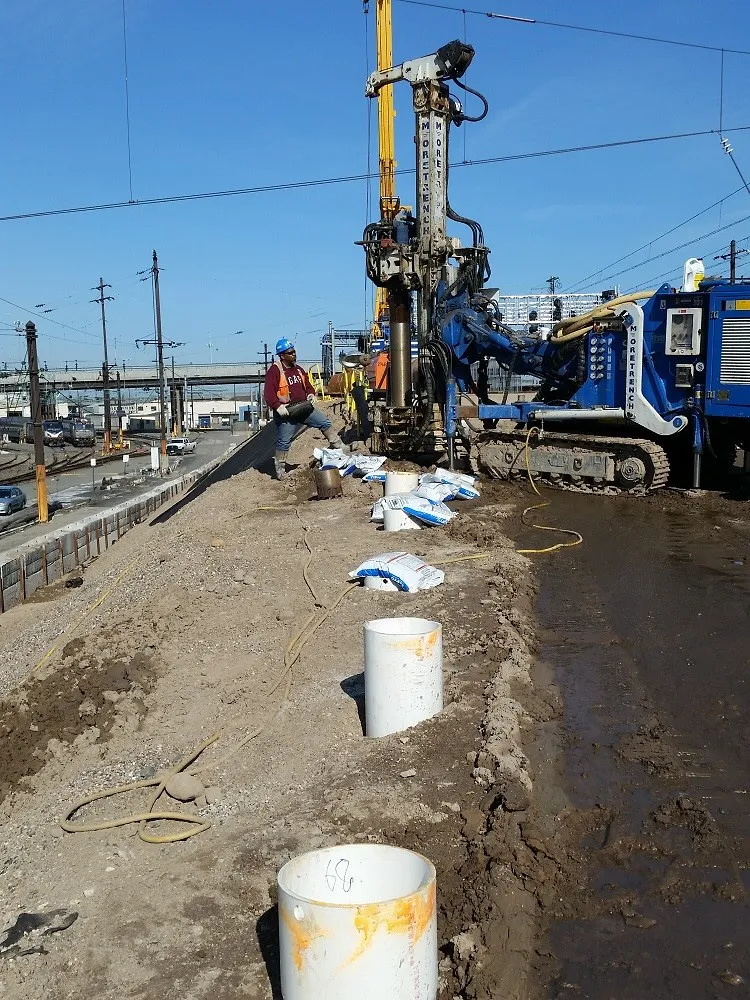
Installing dewatering wells beside a deep excavation. The casings in the foreground will each hold a pump that lowers the water level around the dig. (Photo: MTA C&D - East Side Access, via Flickr · CC BY 2.0 · cropped and resized)
Construction Dewatering: How It Works, Which Method Fits the Soil and What the Rules Require
Dewatering is removing or lowering groundwater, and sometimes surface water, so an excavation can be built in the dry and the soil around it stays stable. The method depends mostly on how fast water moves through the soil. Sumps and pumps handle seepage into a shallow dig. Wellpoints and deep wells lower the water table itself. Whichever you use, the pumped water has rules attached to it, and so does the crew standing in the hole.
This guide covers how the main methods work, how boring and permeability data point to one of them, what OSHA and discharge permits require and how to avoid damaging the neighbors' buildings.
What is dewatering in construction?
On a building site, dewatering is pumping or draining groundwater or surface water out of a foundation excavation, trench, shaft or caisson. It is usually done before the dig reaches the water table, so the water is lowered ahead of the work and not chased after it. The goals are practical. Dry soil carries equipment, keeps electrical gear safe, stays stable on the cut face and lets the contractor place concrete and set pipe to grade.
Dewatering is also a design problem for the geotechnical engineer. The question is how much water will come in, how far the groundwater has to drop and what the drop does to everything around the site.
The main dewatering methods
Four approaches cover most jobs. This table summarizes the descriptions in the Wikipedia dewatering entry, which draws on industry references.
| Method | How it works | Where it fits | Limits |
|---|---|---|---|
| Sumps and open pumping | Water drains to a low pit in the excavation and a submersible or trash pump removes it | Shallow digs, clay and other low-permeability soils, rain and seepage | Water enters the excavation, so cut faces can soften and slough in granular soils |
| Wellpoints | Rows of small slotted tubes, about 50 mm in diameter, are driven near the edge and connected to a vacuum pump | Sandy soils and rock conditions, shallow to moderate drawdown | Suction limits the lift to about 6 m (about 20 ft) in practice, and wellpoints are less effective in clay |
| Deep wells | A drilled borehole with a slotted liner and a submersible pump, often set in a ring around the excavation | Deeper drawdown in permeable soils, where permeability runs from about 10^-3 to 10^-5 m/s | Higher setup cost, and wells form a cone of depression that spreads beyond the site |
| Horizontal drains | A trencher lays perforated pipe, and a pump connects to it | Long, linear lowering at depths up to about 6 m | Layout is tied to the trench line |
Fine silts and clays have very low permeability, so traditional gravity dewatering can be costly or futile there. For those soils the options include vacuum-assisted systems such as ejector wells or vacuum-sealed deep wells. Dewatering is also used to control pore pressure so a deep excavation does not heave at the base.
How soil and borings pick the method
The right method comes from the subsurface data. Three pieces of information matter most.
Soil type and permeability. A boring log that shows clean sand and gravel at the groundwater level points to wells or wellpoints. A log showing stiff clay with occasional silt or sand seams points to sumps, since little water moves through the matrix. Seams and lenses are where surprises come from, so a geotechnical engineer reads the whole profile and not only the average. Our guide to how to read a geotechnical report shows where the groundwater observations and soil descriptions sit in the report.
Water level and how it changes. Groundwater depth recorded while drilling is one reading on one day. Levels move with season and rainfall. Ask the engineer what readings were taken, when and how long after drilling, and whether the design should assume a higher level. The boring program itself, including how deep the borings go, is covered in our soil boring guide.
Excavation depth below the water. The deeper the dig goes below the water table, the more drawdown you need and the more the method choice is driven by the pumping rate. A permeability test or pumping test gives a far better estimate of inflow than a boring log can.
What OSHA and the permit say
Two sets of rules apply no matter how good the system is.
Crew safety. OSHA's excavation standard, 29 CFR 1926.651(h), says employees may not work in excavations with accumulated water, or where water is accumulating, unless precautions are taken. Those can include special support or shield systems, removing water to control the level, or using a safety harness and lifeline. If water removal equipment is what controls the water, a competent person has to monitor the equipment and operation. Excavations subject to runoff from heavy rain need an inspection by a competent person too.
Where the water goes. Pumped water is a discharge. The federal effluent rule for construction sites, 40 CFR 450.21(c), prohibits dewatering discharges unless they are managed by appropriate controls, and the Texas construction general permit, TXR150000, says the same in its 2018 text. That text also lists uncontaminated groundwater, including foundation and footing drains, among the authorized non-stormwater discharges, as long as the flow is not contaminated. Where a site is covered by the permit, the dewatering operation and its discharge point belong on the stormwater plan. Our guide to the SWPPP and Texas construction stormwater rules covers that plan.
EPA's 2022 federal permit goes further in areas where EPA is the permitting authority, which does not include Texas. It adds dewatering inspections, photos of the water before and after treatment and, for discharges to sensitive waters, daily turbidity sampling against a 50 NTU benchmark. Texas operators should read the current TCEQ permit for their own conditions, but the federal text shows where regulators are focused: sediment plumes from poorly controlled pumping can outweigh the sediment a site sheds in storms. Controls usually include sediment bags, a settling tank or basin, and a vegetated discharge area. A direct hose to a creek or storm drain is not a control.
Drawdown, settlement and the neighbors
Lowering the water table has a cost. When the water level drops, the soil above it loses its buoyancy and carries its full saturated weight, and effective stress in the soil goes up. In compressible clays and loose soils that can mean consolidation and settlement, and the effect can reach beyond the site boundary.
Canadian Geotechnical Society's Geotechnical News describes a deep municipal sewer where wells lowered the groundwater below the pipe. The drawdown spread sideways, the foundation soil consolidated under an adjacent housing development, homes settled and cracked, and the dispute ended in litigation. The authors recommend protective measures such as a recharge system. A Chalmers University doctoral thesis on settlement from groundwater drawdown in soft clay reaches a similar conclusion: predictions carry uncertainty in inflow and boundary conditions, so a monitoring and mitigation program is necessary.
On a commercial project near existing buildings, that translates to a short list:
- Survey and photograph adjacent structures and utilities before pumping starts.
- Install observation wells or piezometers outside the excavation and read them on a schedule.
- Set a drawdown limit and a response plan, such as slowing pumping or recharging, before the pumps run.
- Keep the pumping log and the monitoring readings together.
Questions to ask a dewatering contractor
- What water level and permeability did you design to, and where did those numbers come from?
- How is the discharge treated, and where does it go?
- What monitoring is in place for neighbors, and what triggers a change?
- What happens if inflow is higher than predicted?
- Who monitors the pumps overnight and on weekends?
Where the engineering comes in
Choosing a dewatering system starts with the borings, the groundwater readings and a view of what pumping will do to the area around the site. Isbell Engineering Consultants lists groundwater studies and dewatering design among its geotechnical engineering services, including permeability and seepage analysis and temporary or permanent dewatering systems. If an excavation on your project will go below the water table, send the site details through the contact page before the contractor prices it.
Frequently asked questions
What does dewatering mean in construction?
It means removing or lowering groundwater or surface water so an excavation can be built dry and stable. Typical tools are sump pumps, wellpoints, deep wells and drains.
What are the main types of dewatering?
The common ones are sumps with open pumping, wellpoint systems, deep wells and horizontal drains. Soil permeability, excavation depth and how far the water table must drop decide which one fits.
Do I need a permit to discharge dewatering water?
Often a permit condition applies. The Texas construction general permit, TXR150000, prohibits dewatering discharges unless they are managed by appropriate controls, and it lists uncontaminated groundwater among authorized non-stormwater discharges. Larger or contaminated flows can need other permits, so check with TCEQ and your city.
Can dewatering damage nearby buildings?
Yes. Lowering the groundwater raises effective stress in the soil, and compressible soils can settle. Published case histories describe cracked homes beside a pumped sewer excavation. Monitoring and, where needed, recharge are the standard protections.
Sources
- Wikipedia, Dewatering
- 29 CFR 1926.651, Specific Excavation Requirements (OSHA, via Cornell LII)
- TPDES General Permit TXR150000 (2018 text, SAWS-hosted copy)
- TCEQ, Stormwater General Permit for Construction Activities (TXR150000)
- US EPA, 2022 Construction General Permit Final Fact Sheet
- 40 CFR 450.21, Effluent limitations for construction and development (eCFR)
- Persson, J. (2007), Hydrogeological Methods in Geotechnical Engineering: Applied to settlements caused by underground construction, Chalmers University of Technology
- Geotechnical News, March 2016, Geo-Interest: Regional groundwater drawdown (Canadian Geotechnical Society)
Image credits
- A drilling rig and a worker beside white well casings set into a muddy, wet excavation next to a rail yard. Photo: MTA C&D - East Side Access, via Flickr · CC BY 2.0 · cropped and resized
Related articles
Copyright © 2026 Isbell Engineering Consultants - All Rights Reserved.
Made & Managed by North Texas Business Solutions