
Soil Borings: How Many You Need, How Deep They Go and What They Tell You
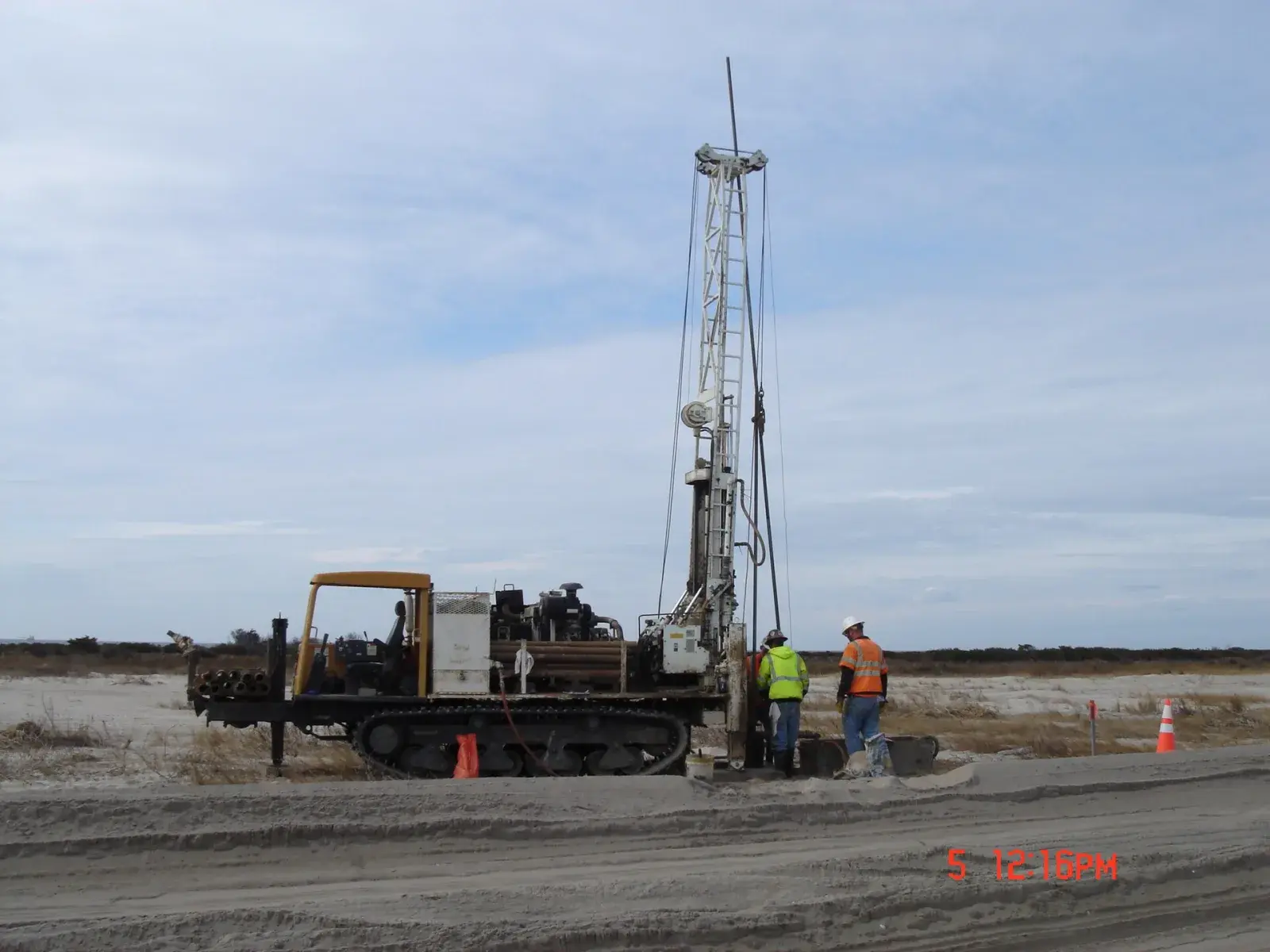
A track-mounted rig set up for a soil boring. The mast carries the augers and the SPT hammer. (Photo: NCDOTcommunications · CC BY 2.0 · cropped and resized)

A soil boring is a small-diameter hole drilled at a planned spot on your site so a geotechnical engineer can pull samples, run field tests and log the layers of soil and rock beneath the building. The number of borings and their depth depend on what you're building and what the ground is doing, and under the building code a registered design professional sets that scope. A few well-placed, deep enough borings are worth far more than a lot of shallow ones.
What happens during a soil boring
Most commercial geotechnical borings are drilled with a truck- or track-mounted rig using hollow-stem or continuous-flight augers. As the hole goes down, the crew stops at set intervals to take a sample. In clay they often push a thin-walled tube (a "Shelby tube") to get a relatively undisturbed sample for lab strength and swell tests. In sand, gravel or very stiff material they drive a split-spoon sampler and record a Standard Penetration Test.
The driller or field engineer writes everything down as they go: depth of each sample, blow counts, color and texture, where groundwater showed up, and where the auger stopped advancing. When the rig hits rock, the crew can switch to coring to recover an intact rock sample. FHWA's soils and foundations manual notes that if bedrock or an obstruction is hit, the boring "may be advanced further by using diamond core drilling."
Lab tests on the samples (moisture, Atterberg limits, gradation, strength, swell) then feed the geotechnical report.
Who decides how many borings you get
The 2021 International Building Code, which Texas cities adopt with local amendments, is direct about this. Section 1803.3.1 says the scope of the investigation, "including the number and types of borings or soundings, the equipment used to drill or sample, the in-situ testing equipment and the laboratory testing program shall be determined by a registered design professional."
So the number shouldn't come from a budget line or the last project. It comes from the building footprint, the loads, the expected foundation type and the geology. Section 1803.4 also requires that the registered design professional have "a fully qualified representative on site during all boring or sampling operations."
How many soil borings and how deep: a starting point
No universal rule exists, and FHWA says so plainly: "no rigid rules apply universally to geotechnical explorations." Its Table 3-13 is still the most widely cited set of minimums. It was written for transportation structures, so treat it as a floor for comparable elements on a commercial site, not a building-code requirement.
| Element | Minimum number of exploration points (FHWA) | Minimum depth (FHWA) |
|---|---|---|
| Retaining wall | At least one per wall; for walls over 100 ft long, every 100 to 200 ft, alternating in front of and behind the wall | 1 to 2 times the wall height below the bottom of the wall, or at least 10 ft into bedrock |
| Shallow foundations | At least one per foundation unit up to 100 ft wide; two if wider | Through any soft or unsuitable soil, and at least to where footing stress drops below 10% of the bearing pressure. In footing widths, about 2 times for a square footing and 4 times for a strip footing. If rock comes first, at least 10 ft into it |
| Deep foundations (piles, drilled shafts) | At least one per foundation unit up to 100 ft wide; two if wider; more if conditions are erratic | At least 20 ft below the expected tip, or twice the pile group width, whichever is deeper. For shafts socketed in rock, at least 10 ft of core or 3 shaft diameters below the tip |
| Embankments and fill | One every 200 ft (erratic ground) to 400 ft (uniform ground) | At least twice the embankment height, deeper through soft layers |
| Cut slopes | One every 200 to 400 ft of slope | At least 15 ft below the bottom of the cut |
Source: FHWA NHI-06-088, Table 3-13.
FHWA adds that in variable ground "it will probably be necessary to exceed the minimum guidelines," and that where large rock-socketed shafts are used, a boring at each shaft location may be justified. The underlying idea is the "depth of significant influence," meaning the zone of soil that will actually feel the building's load. A boring that stops above that zone leaves the most important soil untested.
On a typical commercial site, borings cover the building footprint, with extra borings at retaining walls and ponds and shallower ones in paved areas for pavement design.
Reading the boring log: SPT, CPT and the Texas cone
Standard Penetration Test (SPT)
The SPT is the most common field test in US practice and is run under ASTM D1586. FHWA describes it this way: a 140-pound hammer is dropped 30 inches to drive a 2-inch split-spoon sampler three 6-inch increments. The first increment is a seating drive. The blows for the second and third increments are added together to give the N-value, reported in blows per foot.
FHWA's correlation table (after Peck and others) gives a rough feel for what the numbers mean:
| N60 (blows/ft) | Sand: relative density | N60 (blows/ft) | Silt and clay: consistency |
|---|---|---|---|
| 0–4 | Very loose | Below 2 | Very soft |
| 5–10 | Loose | 2–4 | Soft |
| 11–30 | Medium dense | 5–8 | Medium |
| 31–50 | Dense | 9–15 | Stiff |
| Over 50 | Very dense | 16–30 | Very stiff |
| Over 30 | Hard |
FHWA flags the clay side of that table as "unreliable," which is why geotechs also test clay samples in the lab. A log entry like "50/3" means 50 blows moved the sampler only 3 inches. That usually signals rock, very hard material or an obstruction, and FHWA notes that gravel can plug the spoon and give misleadingly high counts.
Cone Penetration Test (CPT)
A CPT doesn't drill a hole. A rig hydraulically pushes an instrumented cone into the ground at a steady rate and records tip resistance and sleeve friction continuously, under ASTM D5778. FHWA notes that "no borehole, cuttings, or spoil are produced" and that 330 to 1,150 feet of testing can be done in a day. The catch is that you get no physical sample, and FHWA says the CPT is not suited to cemented soils or ground with significant gravel or boulders. Many programs pair a few conventional borings with CPT soundings.
Texas Cone Penetrometer (TCP)
On Texas public work, and on many private projects whose engineers follow TxDOT practice, you'll also see TCP blow counts. A research report for TxDOT describes the TCP as a hybrid of the SPT and the CPT: the hammer energy is similar to the SPT, while the cone shape is similar to the CPT's but larger in diameter. TxDOT uses TCP blow counts to estimate the strength of clay, shale and soft rock for drilled shaft design. If your log shows TCP values, ask the engineer which design method they used them in.
Why North Texas borings often end in shale or chalk
Large parts of North Texas, including much of Dallas–Fort Worth, sit on the Blackland Prairie and Grand Prairie. NRCS describes the Houston Black series, one of the signature clays of those prairies, as very deep soil "formed in clayey residuum derived from calcareous mudstone." Related soils in the same area sit over weathered shale or chalk bedrock, some within 20 to 60 inches of the surface. When dry, Houston Black clay cracks 0.5 to 4 inches wide to a depth of a foot or more.
That geology shapes the boring program in two ways. First, the borings need to go deep enough to describe the clay's swell potential through the zone that gets wet and dry seasonally, because that drives slab and pier design. Second, the engineer often wants to reach the shale or limestone below and test it, because that's where drilled piers usually bear. "Auger refusal" on a log means the auger couldn't advance any further. It may be rock, or it may be a hard layer with softer material below it, so coring or a second test method is sometimes needed to tell the difference.
IBC §1803.5.6 covers this directly: where the rock varies across a site, "a sufficient number of borings shall be drilled to sufficient depths to assess the competency of the rock and its load-bearing capacity."
What the code says the report must include
When an investigation is required, IBC §1803.6 lists what the written report must contain. It includes a plot showing where the borings were drilled, "a complete record of the soil boring and penetration test logs and soil samples," the soil profile, the water table elevation if encountered, foundation recommendations, expected total and differential settlement, deep foundation information, and special provisions for expansive soils. If a report you've been handed is missing the boring location plan or the logs, ask for them.
Owner checklist before you request a geotechnical proposal
- A site plan with the building footprint, finished floor elevation and any retaining walls, ponds and paved areas
- Building type, number of stories and rough column or wall loads, if the structural engineer has them
- Known site history: old fill, demolished buildings, ponds, buried utilities
- Access limits for a truck- or track-mounted rig, and who is calling in utility locates
- Any city or district requirements for the geotechnical report
- Whether you also need pavement design, retaining wall parameters or detention pond recommendations, so borings can be placed for those too
Talk to us about a site investigation
Isbell Engineering Consultants provides geotechnical site investigations, including borehole drilling and test pits, soil sampling and testing, and subsurface profiling, with foundation recommendations for shallow and deep foundations. Because the structural design work happens in the same firm, boring layout can be matched to the actual loads and foundation system. You can review our geotechnical engineering services and structural engineering services, check the FAQ, or send a site plan through the contact page to start scoping.
Frequently asked questions
What is a soil boring test?
It's a drilled hole used to sample and test the soil and rock below a site. The crew records blow counts and soil descriptions in the field and sends samples to a lab. The geotechnical engineer uses the results to recommend a foundation type, bearing pressures and site preparation.
How many soil borings do I need?
It depends on the footprint, loads, foundation type and how variable the ground is. Under IBC §1803.3.1 a registered design professional sets the number. FHWA's minimums, such as at least one exploration point per foundation unit and one per retaining wall, are a common starting point. Variable ground needs more.
How deep should a soil boring be?
Deep enough to get through soft or unsuitable soil and to test the zone the foundation loads. FHWA suggests, for example, at least 20 feet below the expected tip of a pile or drilled shaft, and at least 10 feet of core where foundations bear on rock.
What does the N-value on a boring log mean?
It's the number of hammer blows needed to drive the SPT sampler the last 12 inches of an 18-inch drive. Higher numbers mean denser sand or stiffer clay. A value like "50/3" means refusal: 50 blows moved the sampler only 3 inches.
Sources
- FHWA NHI-06-088, Soils and Foundations Reference Manual, Vol. I, Ch. 3 Subsurface Explorations (Dec 2006)
- 2021 International Building Code as adopted in Texas, Chapter 18 Soils and Foundations (§1803)
- ASTM D1586/D1586M, Standard Test Method for Standard Penetration Test (SPT) and Split-Barrel Sampling of Soils
- ASTM D5778, Standard Test Method for Electronic Friction Cone and Piezocone Penetration Testing of Soils
- Texas Transportation Institute / TxDOT Research Report 0-4862-1, Correlation of Texas Cone Penetrometer Test Values and Shear Strength of Texas Soils
- USDA NRCS Official Soil Series Description, Houston Black
Image credits
- Soil boring crew in safety vests beside a track-mounted geotechnical drill rig with the mast raised. Photo: NCDOTcommunications · CC BY 2.0 · cropped and resized
Related articles
Copyright © 2026 Isbell Engineering Consultants - All Rights Reserved.
Made & Managed by North Texas Business Solutions