
Soil Stabilization on Clay Sites: Lime, Cement, Moisture Conditioning and When to Use Each
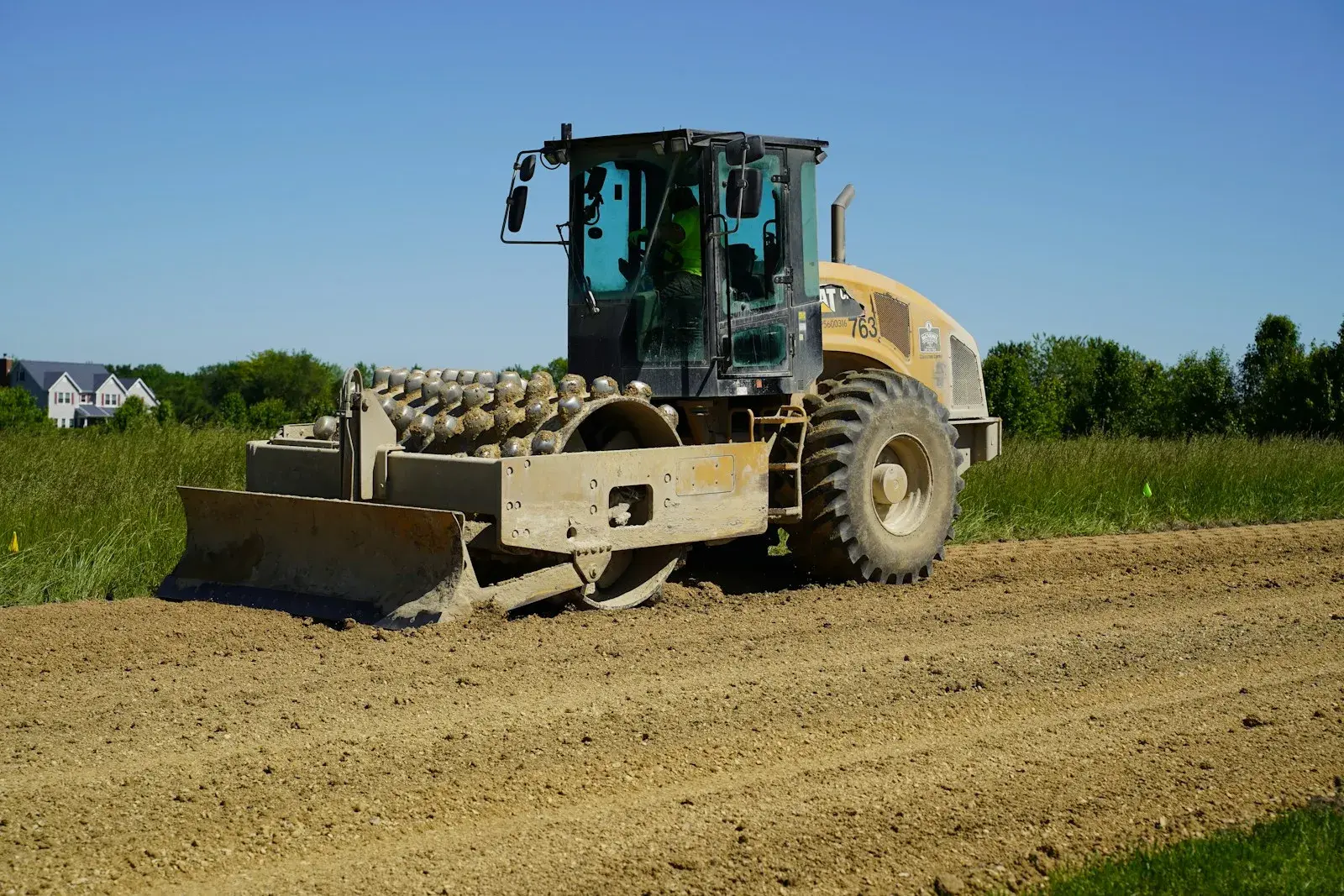
A padfoot roller compacting a roadbed on a full-depth reclamation job. Whatever the additive, the treated layer still has to be mixed, brought to the right moisture and compacted. (Photo: Photo by Evan Porter (@evanporter) on Unsplash · Unsplash License)
Soil stabilization means changing the soil itself so it behaves better under a pavement, slab or embankment. On North Texas clay that usually means one of three things: mixing in lime to cut plasticity and swell, mixing in cement to add strength, or moisture conditioning the clay so it starts out closer to the wet side and swells less later. Picking the wrong one, or skipping the sulfate test, is how a stabilized subgrade ends up heaving instead of holding.
This guide covers how a geotechnical engineer chooses between them, why sulfates are a Texas-specific worry, and what to watch in the field.
Why clay needs stabilizing in the first place
High-plasticity clay causes two separate problems. It's weak and pumps when wet, which makes it a poor platform for pavement and construction traffic. And it swells and shrinks with moisture changes, which moves slabs and pavements after they're built. The 2021 International Building Code (§1803.5.3) treats soil with a plasticity index of 15 or more, along with other index criteria, as expansive.
Different treatments target different problems. Lime mainly attacks plasticity and swell. Cement mainly adds strength. Moisture conditioning addresses swell without changing the soil chemistry. Sorting out which problem you actually have is the first step.
Lime, cement or moisture conditioning: the decision table
| Method | How it works | Best fit | Watch out for |
|---|---|---|---|
| Lime stabilization | Calcium reacts with clay minerals, reducing plasticity and swell; over time a pozzolanic reaction adds strength | Fine-grained clays with moderate to high plasticity; FHWA notes a PI of about 10 is commonly taken as the lower limit for lime | Sulfates in the soil; needs mellowing time and good pulverization |
| Cement stabilization | Cement hydrates and binds particles into a stiffer layer | Lower-plasticity soils; FHWA cites PI below 20 with enough fines passing the No. 40 sieve | High-plasticity clay may need lime pretreatment first; shrinkage cracking; sulfates |
| Lime pretreatment plus cement | Lime breaks down the clay, cement adds strength | High-PI clay where strength is also needed | Two mixing operations, more QA |
| Moisture conditioning | Clay is excavated or processed and recompacted wet of optimum (or water is injected) to reduce future swell | Building pads on expansive clay where the goal is less movement, not more strength | Wet clay is soft to work on; must be protected from drying out before the slab goes on |
| Removal and replacement | Expansive clay replaced with select, low-plasticity fill to a set depth | Building pads where the active zone is shallow enough to be practical | Cost of import and haul-off; drainage so the select fill doesn't become a bathtub |
The IBC gives these options formal standing for buildings. Section 1808.6 lets a designer handle expansive soil by designing the foundation to resist the movement, by removing the expansive soil, or by stabilizing the active zone by chemical, dewatering, presaturation or equivalent techniques, with the building official's approval. The geotechnical report should say which route it assumes.
Sulfate heave: the Texas problem with lime and cement
Some Texas soils contain sulfate minerals such as gypsum. When calcium-based stabilizers like lime or cement meet sulfates and clay in the presence of water, they can form ettringite. FHWA notes that ettringite occupies more than 200% of the volume of its constituents. The result is a treated layer that swells and buckles, sometimes months after construction.
TxDOT developed guidelines specifically for sulfate-rich soils. They tie the approach to measured sulfate content: below roughly 3,000 ppm, mix design proceeds normally with a mellowing period for lime; above that, special measures apply, and at high enough concentrations calcium-based treatment may not be appropriate at all. TxDOT's broader stabilization guidelines use plasticity index and gradation as the main criteria for picking an additive.
The practical takeaway: on any Texas site where lime or cement treatment is on the table, the geotechnical scope should include sulfate testing along the alignment or across the pad, not one sample.
What a stabilization design should specify
A stabilization recommendation is more than "treat with lime." A useful spec covers:
- The additive and the percentage, based on lab testing of the actual soil, not a rule of thumb.
- Treatment depth and limits.
- Sulfate test results and any special measures.
- Mellowing time for lime before final mixing and compaction.
- Pulverization (gradation) requirements.
- Moisture and density targets for compaction.
- Curing and protection until the next layer goes on.
- Testing frequency in the field.
Field QA checklist for lime-treated subgrade
The National Lime Association's construction manual describes the basic sequence: spread, initial mix with water, mellow, final mix and pulverize, compact, cure. The checks that matter most:
- Lime spread rate. Verify with pans or by tracking tonnage over the area treated.
- Water during mixing. Lime treatment needs moisture to react; dry mixing gives a weak result.
- Mellowing. The NLA manual describes a mellowing period, commonly 24 to 48 hours, before final mixing, with the duration set by the mix design.
- Pulverization. The NLA manual cites gradation targets, such as all material passing a 1-inch sieve and at least 60% passing the No. 4 sieve, before compaction.
- Compaction. Density and moisture tests at the frequency in the project specs.
- Curing. Keep the surface moist and protect it from traffic until the next course is placed.
- Watch for heave. Any swelling or surface cracking in the days after treatment on a site with sulfates is a reason to stop and call the geotechnical engineer.
Stabilization for pavements versus building pads
These get lumped together but have different goals. Under pavement, the aim is usually a strong, stable working platform and subgrade support, so lime or cement treatment is common. Under a building slab on expansive clay, the aim is limiting movement, so moisture conditioning, select fill replacement or a structurally designed foundation are the usual tools. A chemically treated layer a few inches thick won't stop movement from deeper clay under a slab. Ask the geotechnical engineer to explain the active zone depth and how the recommended treatment addresses it.
Talk to Isbell Engineering Consultants about clay subgrade or ground improvement
Isbell Engineering Consultants lists ground improvement solutions, including soil stabilization techniques such as compaction, grouting and chemical treatments, and pavement subgrade evaluation and preparation among its geotechnical engineering services. Paving and site grading design are part of our civil engineering services. If you're planning a site on clay and need stabilization recommendations backed by lab testing, contact us.
Frequently asked questions
What is soil stabilization?
Soil stabilization is treating soil, usually by mixing in lime, cement or another additive or by controlling its moisture and density, so it has more strength, less plasticity or less swell. It's common under pavements, building pads and embankments.
Is lime or cement better for clay soil?
For high-plasticity clay, lime is usually the starting point because it reduces plasticity and swell. Cement works better in lower-plasticity soils, and high-plasticity clays often need lime pretreatment before cement. Lab testing on the actual soil should decide.
What is sulfate heave?
Sulfate heave happens when calcium from lime or cement reacts with sulfates and clay minerals in the presence of water to form ettringite, an expansive mineral. The treated layer swells and can damage pavement. Testing for sulfates before treatment is the main defense.
How long should lime-treated soil mellow?
The National Lime Association describes a mellowing period commonly in the range of 24 to 48 hours before final mixing, with the actual time set by the mix design. On sulfate-rich soils, TxDOT guidance calls for special measures, so follow the project-specific recommendation.
Does soil stabilization stop foundation movement on expansive clay?
Not by itself in most cases. A thin treated layer improves the working platform and pavement support, but foundation movement comes from moisture changes through a deeper active zone. Moisture conditioning, select fill or a foundation designed for movement address that, based on the geotechnical report.
Sources
- FHWA NHI-05-037, Geotechnical Aspects of Pavements, Chapter 7 (stabilization)
- TxDOT, Guidelines for Treatment of Sulfate-Rich Soils and Bases in Pavement Structures
- TxDOT, Guidelines for Modification and Stabilization of Soils and Base for Use in Pavement Structures
- National Lime Association, Lime-Treated Soil Construction Manual (Bulletin 326)
- 2021 International Building Code §1808.6 Design for expansive soils (UpCodes)
- 2021 International Building Code, Chapter 18 (§1803.5.3 expansive soil criteria)
Image credits
- A padfoot roller compacting a treated soil roadbed during a full-depth reclamation project. Photo: Photo by Evan Porter (@evanporter) on Unsplash · Unsplash License
Related articles
Copyright © 2026 Isbell Engineering Consultants - All Rights Reserved.
Made & Managed by North Texas Business Solutions