
Detention Ponds in North Texas: How They're Sized Under iSWM
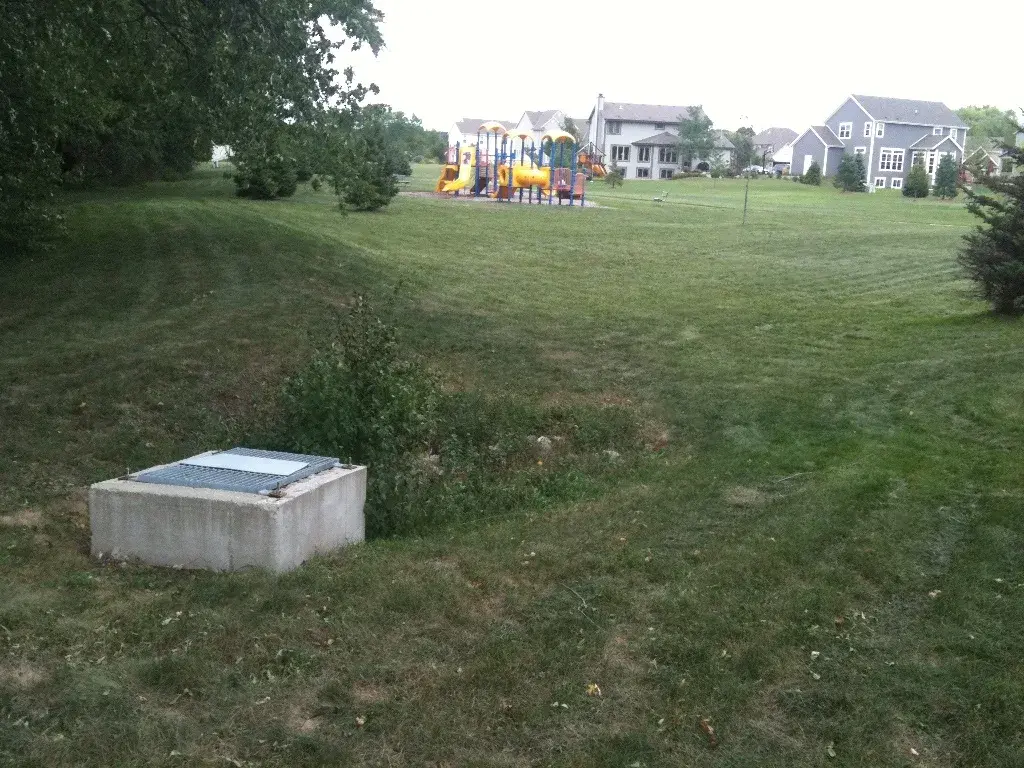
A dry detention pond stays empty between storms. The concrete box is the outlet structure that controls the release rate. (Photo: Aaron Volkening · CC BY 2.0 · cropped and resized)

A detention pond holds stormwater from a developed site for a short time and lets it out slowly, so the property downstream doesn't get more flooding or erosion than it got before you built. In most of Dallas–Fort Worth, a pond is sized against the regional iSWM criteria from the North Central Texas Council of Governments (NCTCOG), as adopted by each city. Under those criteria, the design is checked against four storm events and a downstream assessment. A rule of thumb about acres of pavement doesn't settle it.
Detention pond vs. retention pond
The two terms get swapped constantly. The difference is whether the pond is meant to hold water permanently.
| Detention pond (dry) | Retention pond (wet) | |
|---|---|---|
| Normal condition | Empty between storms | Holds a permanent pool |
| Purpose | Cut peak flow rates, let sediment settle | Store water, treat water quality, sometimes an amenity |
| Outlet | Controlled outlet structure at the bottom | Outlet set above the permanent pool, or none |
| Typical drawdown | EPA describes dry ponds detaining stormwater "for some minimum time (e.g., 24 hours)" | Permanent pool stays |
| Common on | Commercial sites, industrial pads, subdivisions | Larger developments, master-planned communities |
EPA notes that dry ponds "do not have large permanent pools of water," unlike wet ponds. It describes them as suited to drainage areas "typically 10 or more acres." Smaller sites often use underground storage or parking-lot detention instead. The general hydraulic methods for both are laid out in FHWA's HEC-22 urban drainage manual, which states that "procedures for the design of detention facilities are also presented."
How a detention pond is sized under iSWM
iSWM is a cooperative program in which "more than 60 local governments" in North Central Texas share stormwater guidance. Its stated goals are "water quality protection, streambank protection, and flood mitigation." The Criteria Manual says integrated design is based on four storm events:
| iSWM storm event | Design storm | What it controls |
|---|---|---|
| Water quality | First 1.5 inches of rainfall (a volume, not a frequency) | Pollutant capture (the water quality protection volume, WQv) |
| Streambank protection | 1-year, 24-hour | Channel erosion downstream |
| Conveyance | 25-year, 24-hour | Pipes, inlets, channels on and off the site |
| Flood mitigation | 100-year, 24-hour | Flooding of downstream property |
Rainfall depths for these storms come from NOAA Atlas 14, which iSWM adopted for the counties in the NCTCOG region.
For streambank protection, one of the manual's options requires "twenty-four hours of extended detention" for the on-site runoff from the 1-year, 24-hour storm. For flood mitigation, dry detention basins are "sized to temporarily store the volume of runoff required to provide flood protection up to the flood mitigation storm." In practice, the engineer models pre-development and post-development runoff, then sizes the pond and outlet so the post-development release doesn't make things worse downstream at each storm.
The downstream assessment and the 10% rule
The release rate alone doesn't settle the design. iSWM requires a downstream assessment "to protect downstream properties and channels from increased flooding and erosion potential due to upstream development." The assessment runs downstream to a "zone of influence." Under the Hydrology Technical Manual, that's the point where the area draining to the pond "comprises 10% of the total drainage area." The manual's own example: a facility draining 10 acres is checked down to the point where the total drainage area reaches 100 acres.
At each check point, the engineer answers a set of questions. One of them is whether post-development flood heights rise "more than 0.1 feet above the pre-development flood heights." Sometimes the honest answer is that a pond makes timing worse, because delayed flow from your site can coincide with the peak from upstream. That's one reason some sites end up with no detention and downstream improvements instead, where the city allows it.
Design minimums reviewers look for
The iSWM Criteria Manual includes practical requirements for dry basins that show up in plan review comments:
- An 8-foot-wide maintenance access
- No earthen (grassed) embankment slopes steeper than 4:1
- At least 1 foot of freeboard
Cities can and do customize these. Fort Worth adopted an updated Stormwater Criteria Manual that took effect July 15, 2024. Always design to the city's current manual.
Which North Texas cities use iSWM?
NCTCOG lists participating communities on its site. They include Dallas, Fort Worth, Plano, Frisco, Denton, Irving, Lewisville, Grand Prairie, Arlington, Celina, Mansfield, Southlake and others. Each city adopts the criteria with its own changes. Cooke County, Gainesville and McKinney don't appear on that participating list. Jurisdictions outside the list rely on their own drainage rules, so confirm with the city or county engineer which manual applies before any sizing starts.
Construction sediment basins are a different rule
Owners often hear "you'll need a pond" twice: once from the city and once from the stormwater permit. They're separate requirements.
| Permanent detention (city drainage rules) | Temporary sediment basin (TCEQ permit) | |
|---|---|---|
| Rule | City drainage criteria, often based on iSWM | TCEQ Construction General Permit TXR150000 |
| When | Permanent, for the life of the development | During construction only |
| Trigger | City drainage requirements | In the 2018 permit, "where feasible, for a common drainage location that serves an area with ten (10) or more acres disturbed at one time" |
| Sizing | Pre- vs. post-development runoff for the iSWM storms | 2018 permit: runoff "from a 2-year, 24-hour storm from each disturbed acre drained," with an alternative minimum |
Permit coverage itself starts at 1 acre of disturbance. EPA's construction stormwater program covers construction "disturbing 1 acre or more of land," or less than 1 acre if it's part of a common plan of development. The TCEQ permit was reissued in 2023. Check the current TCEQ text, including whether a permanent detention pond can serve as the sediment basin during construction, before relying on any of the figures above.
Maintenance: the part that gets forgotten
A pond that silts up or gets its outlet blocked stops doing its job. Fort Worth's stormwater review page states that "if detention is proposed, a storm water facilities maintenance agreement must be executed." Many cities require something similar, which makes the property owner responsible for mowing, clearing debris and repairing erosion. Budget for that from day one.
Geotechnical questions about ponds
Pond side slopes, embankments and outlet structures sit on soil, and North Texas clay brings its own problems: shrink-swell cracking in embankments, slope stability when slopes are steep or wet, and seepage around outlet pipes. A geotechnical review of pond slopes and embankment fill is worth doing on larger ponds. See our geotechnical engineering services.
Planning detention for your site
Isbell Engineering Consultants provides stormwater runoff analysis, detention and retention pond design, and hydrologic and hydraulic calculations. That work comes alongside grading, drainage and permit-ready civil plans. See our civil engineering services and our guide to what goes in a civil site plan set. To talk through a site, send a survey and concept layout through the contact page.
Frequently asked questions
What is a detention pond?
A detention pond is a basin that temporarily stores stormwater from a developed site and releases it slowly through an outlet structure. It reduces peak flows downstream, and it's normally dry between storms.
What is the difference between a retention pond and a detention pond?
A retention pond holds a permanent pool of water. A detention pond drains down after each storm. Detention controls flow rates. Retention also provides storage and water-quality treatment through the permanent pool.
How is a detention pond sized in North Texas?
In cities using iSWM, the engineer checks four storms: water quality (1.5 inches), streambank protection (1-year), conveyance (25-year) and flood mitigation (100-year, 24-hour). The engineer also does a downstream assessment to the point where the site's drainage area is 10% of the total. Each city may customize these criteria.
Does every commercial site need a detention pond?
No. It depends on the city's drainage criteria and the downstream assessment. Some sites use underground or parking-lot detention, and some show no adverse downstream impact. Ask the city at the pre-application meeting.
When is a SWPPP required in Texas?
Under the TCEQ Construction General Permit, sites disturbing 1 acre or more, or smaller sites that are part of a larger common plan, need permit coverage and a stormwater pollution prevention plan.
Sources
- NCTCOG iSWM program home
- iSWM Criteria Manual (rev. Jan 2015)
- iSWM Technical Manual: Hydrology (April 2020)
- iSWM Participating Cities
- City of Fort Worth, Stormwater Development Review
- TCEQ Construction General Permit TXR150000 (2018 text, SAWS-hosted copy)
- TCEQ 2023 Construction General Permit TXR150000
- EPA, Stormwater Best Management Practice: Dry Detention Ponds (EPA-832-F-21-031A)
- EPA, Stormwater Discharges from Construction Activities
- FHWA HEC-22 Urban Drainage Design Manual, 4th ed. (FHWA-HIF-24-006)
Image credits
- Grassed dry detention pond with a concrete outlet box in a park next to a residential development. Photo: Aaron Volkening · CC BY 2.0 · cropped and resized
- Concrete headwall and outlet pipe with trash rack for a dry detention pond. Photo: Aaron Volkening · CC BY 2.0 · resized

Related articles
Copyright © 2026 Isbell Engineering Consultants - All Rights Reserved.
Made & Managed by North Texas Business Solutions