
SWPPP in Texas: What a Construction Stormwater Plan Must Cover and When You Need One
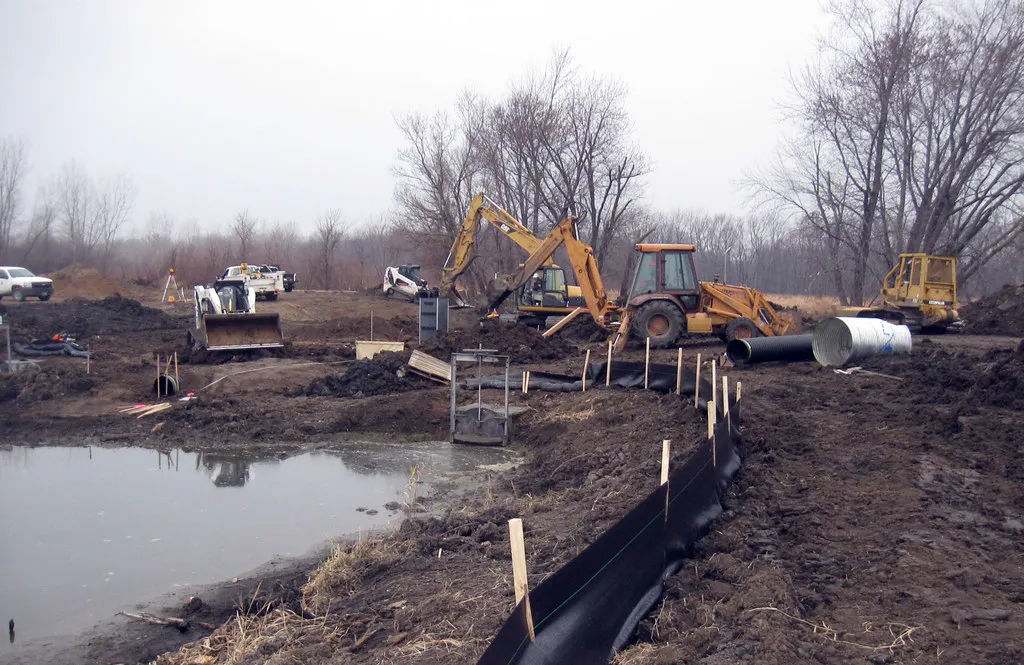
A silt fence along the low edge of a graded site. The fence only works if it is trenched in, staked and cleaned out before sediment reaches half its height. (Photo: Gerry Shimek / U.S. Fish and Wildlife Service - Midwest Region, via Flickr · CC BY 2.0 · cropped and resized)
SWPPP in Texas: What a Construction Stormwater Plan Must Cover and When You Need One
A SWPPP, or stormwater pollution prevention plan, is the written plan for keeping sediment, concrete washout, fuel and trash out of storm drains and creeks while a site is under construction. In Texas you need one when the work disturbs one acre or more of soil, or when it is part of a larger project that will. Texas calls it an SWP3, and it has to exist before any soil is disturbed.
This guide covers when a Texas site needs coverage, what the plan has to contain, how often it gets inspected and why soil type decides whether the controls on the drawings will work.
When does a Texas site need a SWPPP?
Federal rules set the thresholds and Texas applies them through the Texas Pollutant Discharge Elimination System. The Texas Commission on Environmental Quality (TCEQ) issues the construction general permit, TXR150000. The current renewal took effect on March 5, 2023 and runs five years.
The permit sorts sites by the area of land disturbed:
| Disturbed area | Federal definition | What Texas expects |
|---|---|---|
| Under 1 acre, not part of a larger plan | Outside the permit | No permit coverage, but you still use erosion controls and tell the city's storm sewer operator |
| 1 acre to under 5 acres | "Small construction activity", 40 CFR 122.26(b)(15) | A written SWP3 and a posted site notice |
| 5 acres or more | "Large construction activity", 40 CFR 122.26(b)(14)(x) | An SWP3, a Notice of Intent filed with TCEQ and a posted site notice |
Clearing, grading and excavating count. So do demolition, filling pits and stockpiling soil for construction.
The "larger common plan" rule catches people. A 0.75-acre pad in a subdivision that will ultimately disturb 8 acres is not a small site. EPA states that sites under one acre are covered when they are part of a common plan of development or sale that will ultimately disturb one acre or more. TCEQ's guidance treats a project as separate only if it is truly stand-alone, or sits a quarter mile or more from the nearest site with all disturbance between them finished.
Cities add their own steps. The City of Denison, for example, asks small-site operators to post the site notice at least two days before excavation and large-site operators to send the city a copy of the Notice of Intent in the same window. Your city's stormwater office or building department sets the local version.
Who is responsible: primary and secondary operators
The permit puts the duty on operators. TCEQ separates two kinds.
The primary operator has on-site operational control over the plans and specifications, can change them and runs day-to-day activity to keep the site compliant. On most commercial jobs that is the general contractor or the developer. A secondary operator controls the project only by hiring other operators or by approving changes to the plans. An owner who hires a contractor but keeps approval over design changes can land here.
Both have to be named in the plan and sign it. An engineer can draft the SWP3, and many do, but the operator is the one who answers to TCEQ.
What goes in the plan
EPA's 2022 construction general permit lists the contents of a SWPPP, and the Texas permit follows the same logic. A usable plan has these parts:
- The operators and the stormwater team, with the person responsible for inspections named.
- A description of the work: what is being built, the order of activities, the total area to be disturbed and how much is disturbed at each phase.
- A site map showing drainage patterns, slopes, discharge points, the receiving storm drain or creek, the limits of disturbance and where each control sits.
- The non-stormwater discharges expected on site, such as dewatering or hydrant flushing, and how each one is handled.
- A description of every control, with a maintenance note: perimeter controls, inlet protection, a stabilized construction entrance, concrete washout, stockpile protection, temporary and final stabilization.
- Procedures for inspections, maintenance and corrective action.
- Records and the signed certification.
Under Texas rules the SWP3 is prepared before authorization and put in place before soil is disturbed. A copy stays on site, or a notice posted at the entrance says where it is, and it has to be available to inspectors, usually within 24 hours of a request.
How soil decides which controls work
Most national guides give a menu of controls and stop there. The federal effluent rule, 40 CFR 450.21, says more. It requires that the design of erosion and sediment controls address the amount, frequency, intensity and duration of rainfall and the soil characteristics, including the range of particle sizes expected on site.
That clause matters in North Texas. Sand and silt settle out of runoff in a sediment trap fairly quickly. The fine particles in a plastic, expansive clay settle far more slowly, so a small trap that looks fine on paper can pass muddy water straight through. When the geotechnical report or a Web Soil Survey pull shows high-plasticity clay, the plan should lean on keeping soil in place: phased clearing, early stabilization, mulch or erosion blankets on slopes, and longer flow paths through vegetated areas. Our guide to screening a site with Web Soil Survey shows where to find the soil data.
The same rule requires you to minimize the area of exposed soil, limit disturbance of steep slopes and control the volume and velocity of runoff leaving the site. That ties the SWPPP directly to the grading plan and any detention pond, because a pond that is also serving as a sediment basin has to be built early and cleaned out before it goes into service as a permanent facility.
Inspections and maintenance
Keeping the plan true on the ground takes more work than writing it. The 2018 text of TXR150000 sets the inspection rules in Part III, Section F, and the 2023 renewal should be checked for changes. Under that text, trained personnel inspect disturbed areas that are not finally stabilized, material storage areas, discharge points and every structural control. They also look at the construction entrance for off-site tracking.
The schedule is once every 14 calendar days and within 24 hours of the end of a storm of 0.5 inches or more. The alternative is once every seven days with no rain trigger. EPA's 2022 federal permit uses a 0.25-inch trigger instead, which is a reminder that you should follow the permit that applies to your site and not a national checklist.
Some thresholds are written into the permit:
- Silt fence and similar perimeter controls must be cleaned out before trapped sediment reaches 50 percent of the above-ground height.
- Sediment traps and basins must be cleaned out when design capacity is down by 50 percent.
- Soil stabilization has to start immediately where work has stopped, and temporary stabilization has to be finished within 14 calendar days after it starts. Federal rule 40 CFR 450.21(b) uses the same 14-day trigger for areas idle longer than 14 days.
- Records stay with the SWP3 for at least three years after the notice of termination.
When an inspection shows a control failing, the plan gets revised, usually before the next storm. Photos and dated notes in the file are what an inspector asks for first.
Where plans go wrong
- Copied plans. A SWPPP lifted from another site lists controls for a hillside that is flat or omits the creek on this one. The site map has to match the actual drainage.
- Phasing ignored. The plan shows final grades, but the controls have to follow the sequence of work. Perimeter controls go in before the first scrape, and inlet protection before the first storm drain is exposed.
- No owner for inspections. Nobody is named, so nobody walks the site after rain.
- Washout and wash water. The federal rule prohibits concrete washout wastewater unless it is managed by an appropriate control, and wash waters from equipment and wheel washing must be treated before they leave. Designate a place, line it and sign it on the map.
- Dewatering discharged raw. Pumping muddy excavation water to the street counts as a discharge, and it has to go through a sediment control first.
- Termination forgotten. Coverage ends only after final stabilization and a termination notice, where one is required.
Getting the plan and the drawings to agree
The erosion control sheet in a civil plan set is the part of a SWPPP that reviewers check first, and it has to match the grading and drainage sheets. Isbell Engineering Consultants offers civil engineering services that include grading and drainage design, stormwater management and detention design and permit-ready site plans, along with geotechnical engineering services covering site investigations and the design of erosion control measures. See what belongs in a permit-ready civil set, or send your site details through the contact page if soils or drainage on your site are driving the erosion control design.
Frequently asked questions
What does SWPPP stand for?
Stormwater pollution prevention plan. Texas permits call it an SWP3, a stormwater pollution prevention plan under the Texas permit.
Is a SWPPP required in Texas for less than one acre?
Not by itself. A site that disturbs under one acre and is not part of a larger common plan does not need coverage under TXR150000, though TCEQ's guidance says it still has to use erosion controls and notify the municipal storm sewer operator. Local ordinances can be stricter.
Who writes the SWPPP, the engineer or the contractor?
Either can draft it. The permit makes the operators responsible for the plan and for carrying it out, so the primary operator, usually the general contractor or developer, signs it and is accountable for inspections.
How long do I keep SWPPP records?
The 2018 text of TXR150000 requires records to be kept for at least three years from the date the notice of termination is submitted, or from the date coverage ends where no notice is required. Check the 2023 renewal.
Sources
- TCEQ, Stormwater General Permit for Construction Activities (TXR150000)
- TPDES General Permit TXR150000 (2018 text, SAWS-hosted copy)
- TCEQ presentation, The Stormwater Construction General Permit TXR150000 (2021)
- City of Denison, Construction Sites stormwater requirements
- US EPA, Stormwater Discharges from Construction Activities
- US EPA, Developing a Stormwater Pollution Prevention Plan (SWPPP)
- US EPA, 2022 Construction General Permit Final Fact Sheet
- 40 CFR 450.21, Effluent limitations for construction and development (eCFR)
- 40 CFR 122.26, Storm water discharges (definitions of large and small construction activity)
Image credits
- Black silt fence on wooden stakes along the edge of a graded construction site, with an excavator and loader working behind it. Photo: Gerry Shimek / U.S. Fish and Wildlife Service - Midwest Region, via Flickr · CC BY 2.0 · cropped and resized
Related articles
Copyright © 2026 Isbell Engineering Consultants - All Rights Reserved.
Made & Managed by North Texas Business Solutions