
Geotechnical Engineering Explained for Owners and Developers
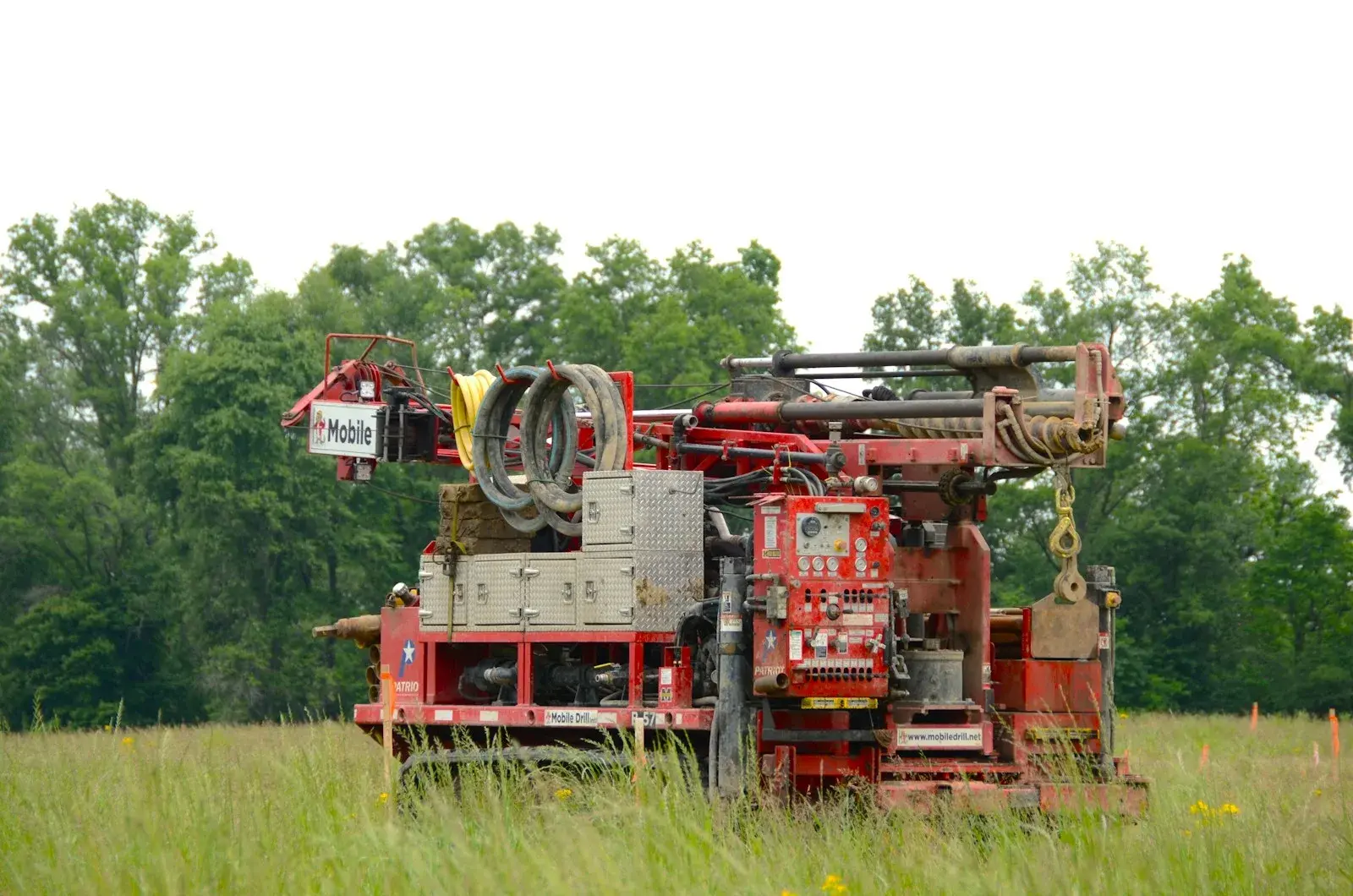
A track-mounted drill rig of the kind used for soil borings on undeveloped sites. (Photo: Photo by Roger Starnes Sr (@rstar50) on Unsplash · Unsplash License)
Geotechnical engineering is the branch of civil engineering that works out how soil, rock and groundwater will behave once you build on them. For an owner or developer, it answers practical questions before money goes into the ground: what kind of foundation the building needs, how thick the pavement should be, whether the site needs fill or soil treatment, and how much the ground might move. In North Texas, where many sites sit on clay that swells and shrinks with moisture, those answers can change the foundation budget more than any other single item.
What geotechnical engineering covers
Geotechnical engineering draws on soil mechanics, rock mechanics, geology and hydrology. On a building or site development project, the work usually falls into four parts:
- Site investigation. Drilling borings or digging test pits, sampling soil and rock, and logging what comes out.
- Laboratory testing. Classifying the soils and measuring moisture, plasticity, strength, swell and compressibility.
- Analysis and recommendations. Bearing capacity, settlement, expansive soil movement, slope stability, lateral earth pressures on walls, pavement support and groundwater effects.
- Construction phase work. Checking that the soil exposed in excavations matches what was assumed, and that fill is placed and compacted as specified.
What does a geotechnical engineer do on your project?
Think of the geotechnical engineer as the person who tells the structural and civil engineers what the ground can handle. Each piece of their work feeds a specific design decision.
| Geotechnical deliverable | Decision it drives | Who uses it |
|---|---|---|
| Boring logs and soil profile | Whether the site is uniform enough for one foundation type | Structural engineer, owner |
| Allowable bearing pressure and settlement estimate | Size and depth of footings, or a move to deep foundations | Structural engineer |
| Swell potential / expansive soil parameters | Slab type (on-grade, post-tensioned, structural slab on piers), moisture control, soil treatment | Structural engineer, civil engineer |
| Drilled pier or pile capacities | Pier diameter, depth and spacing | Structural engineer |
| Lateral earth pressure and soil parameters for walls | Retaining wall type and size | Structural or civil engineer |
| Subgrade support values | Pavement thickness, subgrade treatment for parking and drives | Civil engineer |
| Groundwater observations | Dewatering, drainage, waterproofing | Contractor, civil and structural engineers |
| Earthwork and fill specifications | How fill is placed, compacted and tested | Contractor, testing lab |
If you take away one point, it's this: without that report, the structural engineer has to make conservative assumptions, and conservative usually means bigger, deeper and more expensive. FHWA's soils and foundations manual says the same thing plainly, noting that without an adequate subsurface exploration program the result is generally an extremely conservative foundation recommendation.
When is a geotechnical investigation required?
Under the 2021 International Building Code, §1803.2, geotechnical investigations are required as described in the rest of §1803, although the building official may waive the requirement where satisfactory data from adjacent areas is available. The code also says what the investigation must look at, including slope stability, soil strength, load-bearing capacity, the effect of moisture variation, compressibility, liquefaction and expansiveness (§1803.3).
When a report is prepared, IBC §1803.6 lists what it must contain. In plain terms:
- A plot showing where borings or test pits were made
- Boring logs and penetration test results
- A soil profile
- Water table elevation, if groundwater was found
- Recommended foundation type and design criteria
- Expected total and differential settlement
- Deep foundation information where applicable
- Special design provisions for expansive soils
- Compacted fill properties and testing requirements
Local practice varies. Many North Texas cities expect a geotechnical report with any commercial building permit, so check with the building department before you assume yours will be waived.
How a geotechnical investigation is planned
There's no single rule for how many borings a site needs. FHWA's reference manual gives minimum guidelines by structure type and stresses that they're only a first step; erratic soils or rock call for more. For shallow foundations, it recommends exploring deep enough to get through unsuitable soils into competent material and to where the footing's added stress becomes small. For deep foundations, it recommends going at least 20 feet below the expected pier or pile tip, or twice the maximum group dimension, whichever is deeper, and coring at least 10 feet into rock where piers bear on rock.
The geotechnical engineer sets the plan based on the building footprint, the loads, the site geology and what the borings show as drilling goes on. When you request a proposal, give them a site plan with the building location, approximate column loads or building type, finished floor elevation, and any planned cuts, fills or retaining walls. Better inputs mean a better-targeted investigation.
Why North Texas soils make geotechnical work matter
Large parts of North Texas sit on clay soils with high shrink-swell potential. The USDA's description of the Houston Black series, one of the best-known Texas clays, notes high shrink-swell potential and dry-season cracks from half an inch to four inches wide extending a foot or more deep. NRCS maps it across the Blackland Prairies and the eastern Grand Prairie of Texas. You can check your own site's mapped soils in USDA Web Soil Survey, though that's a screening tool, not a substitute for borings.
FHWA's manual explains why this matters. Expansive clays are a known problem in semi-arid regions including Texas, where long dry spells are followed by intense rain. Most of the movement happens in the upper 3 to 10 feet, called the active zone, which is also where shallow foundations and slabs live. As a rough indicator, FHWA notes that soils with a plasticity index below 15 generally won't show expansive behavior, while higher-PI soils need more evaluation.
The IBC has its own definition. Under §1803.5.3, soil is classified as expansive if it meets all of these: plasticity index of 15 or more, more than 10 percent passing a No. 200 sieve, more than 10 percent of particles smaller than 5 micrometers, and an expansion index above 20. If the expansion index test is run, the first three don't need to be shown. Once soils are expansive, §1808.6 requires foundations to be designed for the volume change or the soil to be removed or stabilized.
That's why the same building can need a simple slab on one site and a structural slab on drilled piers a few miles away. We cover one of those options in our article on suspended foundations.
During construction
Geotechnical work doesn't end at the report. IBC Table 1705.6 lists soil special inspections, including verifying that excavations reach the right depth and material, that the bearing material can carry the design pressure, and that fill materials, placement and compaction meet the specifications. Keeping the geotechnical engineer involved means someone who knows the borings is looking at the open excavation, which is where unexpected soft spots, fill or groundwater show up.
Isbell's geotechnical engineering services
Isbell Engineering Consultants provides geotechnical engineering services from Valley View, Texas, including site investigations (soil sampling and testing, borehole drilling and test pits), soil and rock mechanics analysis, shallow and deep foundation recommendations, earth retaining wall soil parameters, pavement subgrade parameters, ground improvement, groundwater studies and instrumentation and monitoring. Common questions are answered on the FAQ page. To scope an investigation for your site, send a site plan and project description through the contact page.
Frequently asked questions
What is the difference between geotechnical engineering and structural engineering?
Geotechnical engineering deals with the ground: soil and rock properties, groundwater, bearing capacity, settlement and soil movement. Structural engineering deals with the building's frame and foundation elements. The geotechnical engineer recommends foundation types and design values; the structural engineer uses them to design the actual foundation.
Is a geotechnical report required for a building permit?
Under IBC §1803.2 a geotechnical investigation is required, but the building official can waive it where satisfactory data from nearby sites exists. Many cities expect a report for commercial buildings. Confirm with your local building department.
How long does a geotechnical investigation take?
It depends on site access, the number of borings, lab testing and the drilling schedule. Ask the geotechnical engineer for a schedule with the proposal, and order the investigation early so the structural design isn't waiting on it.
Can I use an old geotechnical report for a new building?
Sometimes, if it covers the same footprint and loads and conditions haven't changed. A geotechnical engineer should review it first, since the borings may not be where the new building sits or deep enough for the new loads.
What does a geotechnical engineer look for in North Texas clay?
Mainly how much the clay can swell and shrink, how deep the moisture changes reach, and where firmer soil or rock sits for piers. Plasticity index, moisture content and swell tests are the usual starting points.
Sources
- 2021 IBC Chapter 18, Soils and Foundations (Texas, via UpCodes): §1803.2, §1803.3, §1803.5.3, §1803.6, §1808.6
- FHWA NHI-06-088, Soils and Foundations Reference Manual, Volume I (2006)
- USDA NRCS, Official Series Description: Houston Black series
- 2021 IBC Chapter 17, Special Inspections and Tests, Table 1705.6 Soils (Texas, via UpCodes)
- Wikipedia, Geotechnical engineering
Image credits
- Track-mounted geotechnical drill rig set up in a grassy field for soil borings. Photo: Photo by Roger Starnes Sr (@rstar50) on Unsplash · Unsplash License
Related articles
Copyright © 2026 Isbell Engineering Consultants - All Rights Reserved.
Made & Managed by North Texas Business Solutions