
Building on North Texas Expansive Clay: What PVR Means for Your Foundation
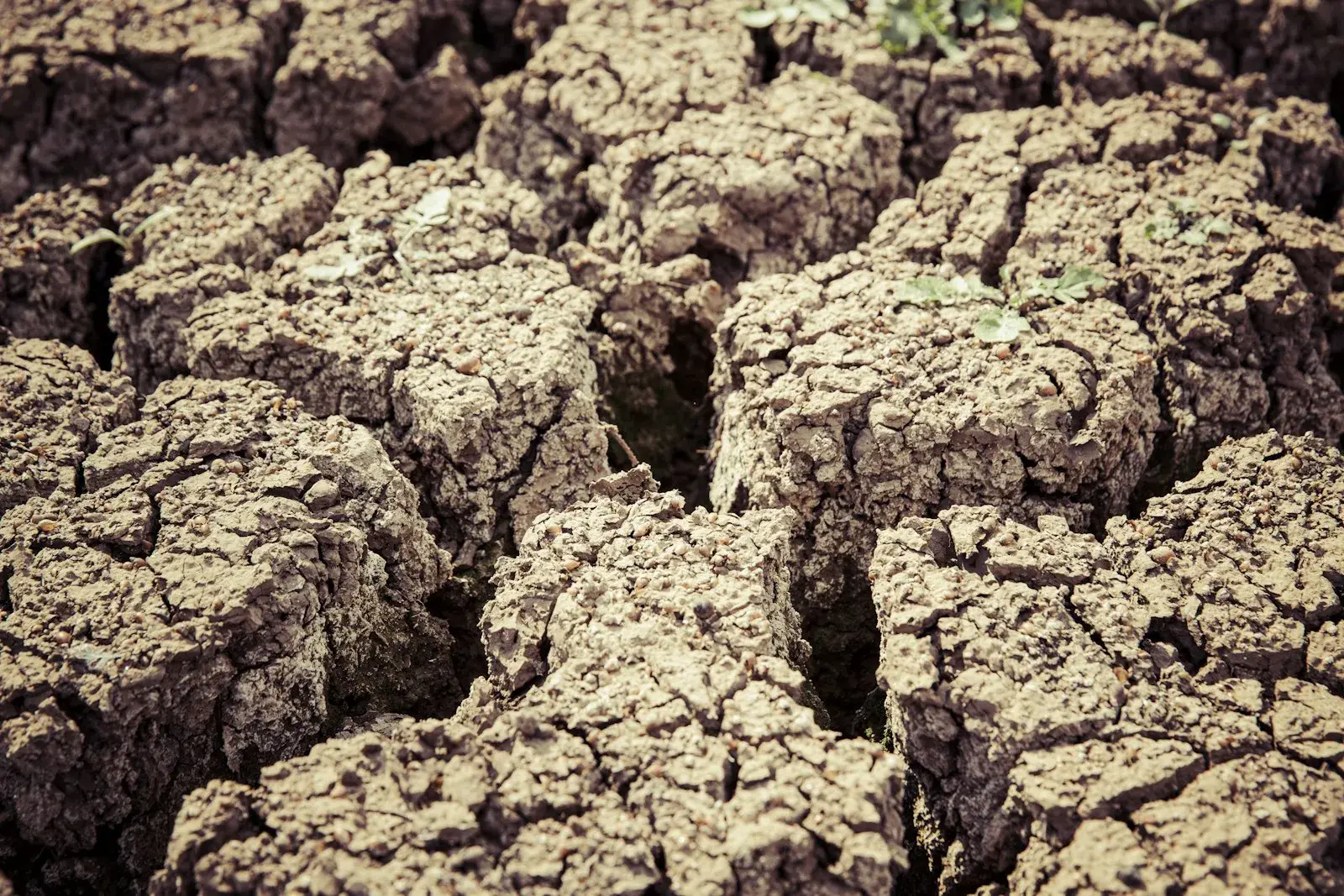
Clay that has dried out pulls apart into blocks. When it gets wet again, it swells and closes those cracks. (Photo: Photo by Markus Spiske on Unsplash · Unsplash License)
Expansive clay swells when it takes on water and shrinks when it dries, and a lot of North Texas sits on it. A foundation built on top rides that movement unless it's designed for it. In Texas, the number most engineers use to size up the problem is potential vertical rise (PVR): an estimate, in inches, of how far the ground could heave if it went from dry to wet. Your geotechnical report gives you that number, and it does a lot to decide whether you get a simple slab, a post-tensioned slab or a structural slab on drilled piers.
What makes North Texas clay expansive
The problem comes from the clay minerals. Smectite clays such as montmorillonite take water into their structure and change volume far more than other soils do. When those clays dry, they crack. When they wet, they swell and push up on anything resting on them.
The best-known example here is the Houston Black series. USDA's official description gives it high shrink-swell potential, with dry-season cracks half an inch to four inches wide reaching a foot or more deep. Those cracks stay open 90 to 150 cumulative days in most years. NRCS maps the series across the Blackland Prairies and the eastern Grand Prairie of Texas and calls it a soil of large extent. Water gets into it fast when it's dry and cracked and very slowly once it's moist. That's why a dry summer followed by a wet fall is hard on foundations.
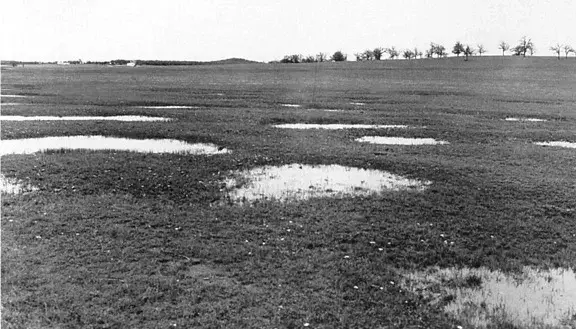
You can sometimes see the movement in an open field. Long-term shrinking and swelling builds gilgai, a pattern of small humps and hollows. On Houston Black soils NRCS describes the humps as 3 to 18 inches higher than the hollows, repeating every 10 to 24 feet.
A soil map won't tell you what's under your building pad. North Texas also has shallow limestone, sandy terraces and plenty of old fill. Mapped soils are a starting point. The borings are what count.
How the code defines expansive soil
The 2021 International Building Code, which Texas jurisdictions build their local codes from, classifies soil as expansive under §1803.5.3 when all four of these are true:
- Plasticity index (PI) of 15 or more
- More than 10 percent passing the No. 200 sieve
- More than 10 percent of particles finer than 5 micrometers
- Expansion index above 20
If the lab runs the expansion index test, the first three don't have to be shown. Once a soil counts as expansive, §1808.6 says the foundation must be designed to resist the volume change, or the expansive soil has to be removed or stabilized.
FHWA's soils and foundations manual adds some context. Expansive clay is a known problem in semi-arid places like Texas, where long dry spells end in heavy rain. Most of the movement happens in the top 3 to 10 feet, the "active zone," and that's where slabs and shallow footings sit.
What PVR is and where the number comes from
TxDOT test method Tex-124-E defines potential vertical rise as the potential of a soil to swell at a given density, moisture and loading when it's exposed to capillary or surface water. That swelling raises the ground surface and anything resting on it. The method dates to McDowell's work in the 1950s. It works from routine lab data instead of a special test. For each soil layer you need:
- Layer thickness
- Moisture content and density
- Liquid limit and plasticity index
- Percent passing the No. 40 sieve
The geotechnical engineer adds up the swell layer by layer through the soil column and reports a total in inches. For pavements, TxDOT's design manual recommends analyzing a 15-foot soil column and caps design PVR at 1.5 inches for main lanes. That limit is for highways, not buildings. For a building, your engineers set their own target.
For residential work, the Texas Section of ASCE goes a step further. Its Recommended Practice for the Design of Residential Foundations asks the geotechnical report to estimate soil movement from the active zone depth plus at least two methods. PVR by Tex-124-E (dry to wet) is one option. Swell tests, suction tests and linear shrinkage are others. Many commercial geotechnical reports follow a similar approach. PVR is quick and familiar, but it's an empirical estimate. It isn't a measured swell.
The expansive-soil numbers in your geotechnical report
| Value in the report | What it tells you | Who uses it |
|---|---|---|
| PVR (inches) | Estimated heave of the soil column if it goes from dry to wet | Structural engineer, owner (budget) |
| Active zone depth | How deep seasonal moisture change reaches | Pier depth, depth of soil treatment |
| Plasticity index / weighted PI | How plastic, and usually how expansive, the clay is | Slab design methods (BRAB/WRI), screening |
| Swell test results | Measured swell of samples under load | Checks the PVR estimate |
| PTI em and ym | Edge-moisture distance and differential movement for edge lift and center lift | Post-tensioned slab design |
| Pier uplift and skin friction | Uplift force swelling clay puts on piers, and capacity below the active zone | Drilled pier design |
| Treatment recommendations | Depth of removal and replacement, lime treatment or moisture conditioning needed to reduce PVR | Civil and structural engineers, earthwork contractor |
For a deeper look at the lab side, see our geotechnical engineering services page.
How PVR drives the foundation choice
The code gives you two routes. You can design the foundation to tolerate the movement, or you can change the soil so there's less movement to design for. Most North Texas projects use some of both.
| Approach | How it handles expansive clay | Code reference | Where it tends to fit |
|---|---|---|---|
| Remove and replace | Dig out expansive clay to the specified depth and replace it with select, non-expansive fill | IBC §1808.6.3 | Lower PVR sites; pads where earthwork is already heavy |
| Stabilize the active zone | Lime or other chemical treatment, presaturation or moisture conditioning to cut swell potential | IBC §1808.6.4 | Building pads and pavement subgrade |
| Stiffened slab-on-ground | Slab with deep grade beams, designed to WRI/CRSI methods | IBC §1808.6.2 | Moderate movement, light buildings |
| Post-tensioned slab | Slab designed to PTI DC 10.5 using em and ym from the report | IBC §1808.6.2 | Common for light buildings on moderate to high movement clay |
| Structural slab on drilled piers | Slab spans between piers founded below the active zone, with a void space so swelling clay can't push the slab | IBC §1808.6.1 | High PVR, movement-sensitive floors, heavier buildings |
The choice usually comes down to cost against the movement the building can take. A warehouse floor with forklifts, a school gym and a lab with sensitive equipment each have different limits. We covered the plumbing side of a suspended floor in suspended foundations and plumbing.
Piers bring their own expansive-soil issue. Swelling clay grips the pier shaft and pulls up on it. The ASCE Texas guidance asks reports to give uplift pressures and active zone depth, because the pier has to be anchored below the active zone to resist that pull.
Reducing PVR before you build
Treating the soil is often cheaper than building a heavier foundation. Common methods on North Texas pads:
- Removal and replacement. The top several feet of clay come out and go back as compacted select fill. The geotechnical report gives the depth needed to bring PVR down to the target.
- Lime treatment. Mixing lime into the upper clay reduces plasticity and swell. It works best near the surface and is common under pavements.
- Moisture conditioning. Water is injected or the soil is reworked at a moisture content above optimum, so it has already swelled before the slab goes on.
Any of these only works if the earthwork contractor builds what the report specifies, and someone tests it. Fill placement and compaction are special inspection items under IBC Table 1705.6. Budget for density testing and moisture checks during the pad work.
Keeping moisture steady after construction
A foundation designed for expansive clay still depends on how the site is kept up. Most damaging movement comes from uneven moisture: one side of the building stays wet while the other dries out. The ASCE Texas residential guidance lists the basics. They're worth copying into any owner's maintenance plan, commercial or not:
- Keep the top of the slab at least 8 inches above the finished grade next to it.
- Slope exposed or planted ground away from the foundation at 5 percent or more for the first 10 feet, and at least 2 percent beyond that.
- Keep the bottom of any drainage swale at least 4 feet from the foundation.
- Run gutter downspouts out at least 2 feet from the foundation and past planting beds.
- Keep trees and large shrubs away from the foundation, taking each species' water demand into account.
- Fix leaking water and sewer lines quickly, and don't overwater beds right against the building.
The same guidance warns about trees removed shortly before construction. The ground where they stood can be drier than the rest of the site and heave locally once the building is up. Mention any recent clearing to your geotechnical engineer.
Checking a site before you buy
USDA Web Soil Survey and the USGS swelling clays map will show you whether a parcel sits in an area mapped as high shrink-swell. They're useful for early screening and for knowing what to ask. They won't replace borings. Clay depth, fill, limestone and groundwater all vary within a single lot. If expansive clay is likely, plan for borings deep enough to get through the active zone, and for lab tests that support a PVR or swell estimate.
Talk to an engineer about your site
Isbell Engineering Consultants, based in Valley View, Texas, provides geotechnical site investigations, soil and rock mechanics analysis, shallow and deep foundation recommendations and ground improvement recommendations. On the structural side, it designs foundations and coordinates with the geotechnical engineer. If you're planning a commercial, industrial or municipal building on North Texas clay, send a site plan and a short project description through the contact page to scope an investigation.
Frequently asked questions
What is expansive clay?
Expansive clay is soil rich in clay minerals, mainly smectites such as montmorillonite, that swell when they absorb water and shrink when they dry. Under IBC §1803.5.3, soil is expansive if it has a PI of 15 or more, enough fine particles and an expansion index above 20.
What is a good PVR for a foundation?
There's no single code number for buildings. TxDOT limits design PVR to 1.5 inches for highway main lanes, but building targets are set by the structural and geotechnical engineers based on the foundation type and how much movement the building can tolerate. Ask your geotechnical engineer what treatment would bring PVR down to the level your foundation design assumes.
What is the best foundation for expansive clay soil?
It depends on how much movement is expected and what the building can tolerate. Post-tensioned slabs and stiffened slabs suit many light buildings. Structural slabs on drilled piers founded below the active zone are used where PVR is high or floors are sensitive. Soil treatment can make a lighter foundation workable.
How deep does expansive clay movement go?
FHWA notes that most movement occurs in the upper 3 to 10 feet, the active zone. The actual depth varies by site and climate, so the geotechnical report should state it.
Does Web Soil Survey tell me if my lot has expansive clay?
It shows the mapped soil series and shrink-swell ratings for the area, which is good for screening. It can't show fill, local variation or the depth to rock under your building, so you still need borings.
Sources
- USDA NRCS, Official Series Description: Houston Black series
- TxDOT, Tex-124-E Potential Vertical Rise of Natural Subgrade Soils (effective January 2017)
- TxDOT Pavement Design Manual, Section 2: Geotechnical Investigation for Pavement Structures (PVR soil column and allowable PVR)
- Texas Section ASCE, Recommended Practice for the Design of Residential Foundations, Version 2 (adopted October 4, 2007)
- 2021 IBC Chapter 18, Soils and Foundations (Texas, via UpCodes): §1803.5.3, §1808.6
- 2021 IBC Chapter 17, Special Inspections and Tests, Table 1705.6 Soils (Texas, via UpCodes)
- FHWA NHI-06-088, Soils and Foundations Reference Manual, Volume I (2006)
- USGS, Swelling Clays Map of the Conterminous United States, Map I-1940 (Olive and others, 1989)
- Wikipedia, Expansive clay
Image credits
- Deep shrinkage cracks in dried expansive clay soil. Photo: Photo by Markus Spiske on Unsplash · Unsplash License
- Gilgai microrelief on a Texas clay field, with water standing in shallow depressions. Photo: USDA Natural Resources Conservation Service · Public domain (US gov)

Related articles
Copyright © 2026 Isbell Engineering Consultants - All Rights Reserved.
Made & Managed by North Texas Business Solutions